
Agent Verification Compliance in India: Complete 2026 Guide
Hiring or onboarding agents like field salespeople, delivery partners, collection agents, gig workers, and call-center agents is routine for many Indian businesses. But collecting identity documents, running background checks, using Aadhaar/e-KYC, or storing verification records now sits inside a tighter legal and regulatory cage than ever. This guide explains the legal landscape (2023–2026), practical must-dos, and a compliant operational checklist so your agent verification program stays lawful, defensible, and business-friendly.
The legal framework you must know
Digital Personal Data Protection Act (DPDP), 2023. The DPDP Act is India’s central data-protection statute for digital personal data. It sets obligations on lawful processing, purpose limitation, data minimization, consent, data subject rights, and cross-border transfers, all highly relevant when you collect and process agent data for verification.
Aadhaar/e-KYC rules. Aadhaar-based authentication and e-KYC are powerful for identity verification, but their use is strictly regulated. The UIDAI and successive government clarifications place limits on when private entities may authenticate with Aadhaar and require secure handling, consent, and logging of authentication transactions. Recent clarifications and rule changes continue to evolve, so treat Aadhaar use as high-control with mandatory documentation.
Sectoral KYC / AML rules (RBI, financial regulators). If your agents interact with financial services (collect payments, open accounts, sell financial products), the Reserve Bank of India’s KYC and AML directions apply. These include due diligence on agents, record-keeping for onboarding, and sometimes stricter onboarding methods (video KYC, certified documents, and CKYCR).
Police verification and local requirements. For certain roles (domestic help, security, drivers, or placements in sensitive environments), police verification is commonly required or recommended by state/local authorities. For informal hires, the absence of such checks has been highlighted as a recurring risk. Check local rules and internal risk tolerance before skipping police verification.
What “agent verification compliance India” actually means (operationally)
At its core, compliance means you can answer: why you collected each piece of data, whether the agent consented (and you logged it), how you secured the data, how long you will retain it, who you shared it with (vendors, banks, background-check providers), and how you handle an agent’s request to view, correct, or delete their data.
Key pillars:
- Legal basis & documented purpose—map every data field to a lawful purpose (e.g., identity check, payment settlement, regulatory KYC).
- Consent & notices—provide clear, language-appropriate notices and capture consent for non-contractual processing.
- Data minimization—collect only what’s necessary: avoid storing full Aadhaar numbers unless essential.
- Secure processing & vendor controls—vet background-check vendors and get written data-processing agreements.
- Retention & deletion—publish retention periods and implement secure deletion.
- Rights & grievance process—operationalize data-subject access and complaint handling under DPDP.
(Each of the above is anchored in the DPDP Act and related sectoral guidance.)
Practical checklist: before, during, and after verification
Before onboarding (policy + contracts)
- Map the data flow—what you collect, why, where it's stored, and who accesses it. (Create a simple data inventory.)
- Update employment/agent contracts and screening consent forms with clear DPDP-compliant clauses.
- Run DPIAs (Data Protection Impact Assessments) for high-risk processes (Aadhaar Auth, criminal record checks, biometric processing).
During verification
- Capture explicit, granular consent for any background checks and Aadhaar (if used). Log timestamps and the exact consent text.
- Prefer non-sensitive alternatives: use PAN, passport, driving license, or DigiLocker-certified documents instead of storing Aadhaar where possible.
- When using third-party BGV vendors, ensure written DPAs (data-processing agreements) that cover security, breach notification, and audit rights.
After verification
- Store only derived verification results (pass/fail, verification date, and verification method) rather than reproducing entire source documents.
- Implement role-based access controls and encryption at rest/in transit.
- Keep audit logs for authentication and consent events; these are critical for regulatory defense.
- Retain KYC/verification records per sector rules (banks/NBFCs have longer retention needs) and then securely delete.
Special cases & red flags
- Aadhaar authentication: Treat Aadhaar as a special category—log consent, authentication transaction IDs, and avoid storing Aadhaar numbers unless authorized. Check UIDAI rules and any recent government notifications before using Aadhaar for private-sector verification.
- Criminal record checks: These carry both legal and reputational risks. Obtain explicit consent, limit scope to job-relevant information, and follow local police or court rules for accessing records.
- Cross-border processing: If you transfer agent data outside India, comply with DPDP cross-border rules and document safeguards.
Best practices that reduce risk and cost
- Use DigiLocker and certified electronic documents—faster, auditable, and less risky than photocopies.
- Adopt identity-verifiable micro-workflows—e.g., video KYC for remote agents combined with OTP/eKYC reduces fraud. Ensure video capture policies meet DPDP standards.
- Centralize consent & records for quick subject-access fulfillment.
- Train HR and field managers on what to ask, what not to store, and how to handle sensitive requests.
- Quarterly vendor audits—verify SOC/ISO reports and run sample data flows.
Closing: compliance as a business enabler
Agent verification compliance in India is not just legal housekeeping—it builds trust with regulators, partners, and agents themselves. A lean, documented approach (minimal data, clear consent, strong vendor controls, and auditable logs) reduces hiring friction while keeping liability low. Start with a short data inventory and a one-page verification policy—then scale the controls to match risk.
Make Agent Verification Compliance Effortless with Gigin AI
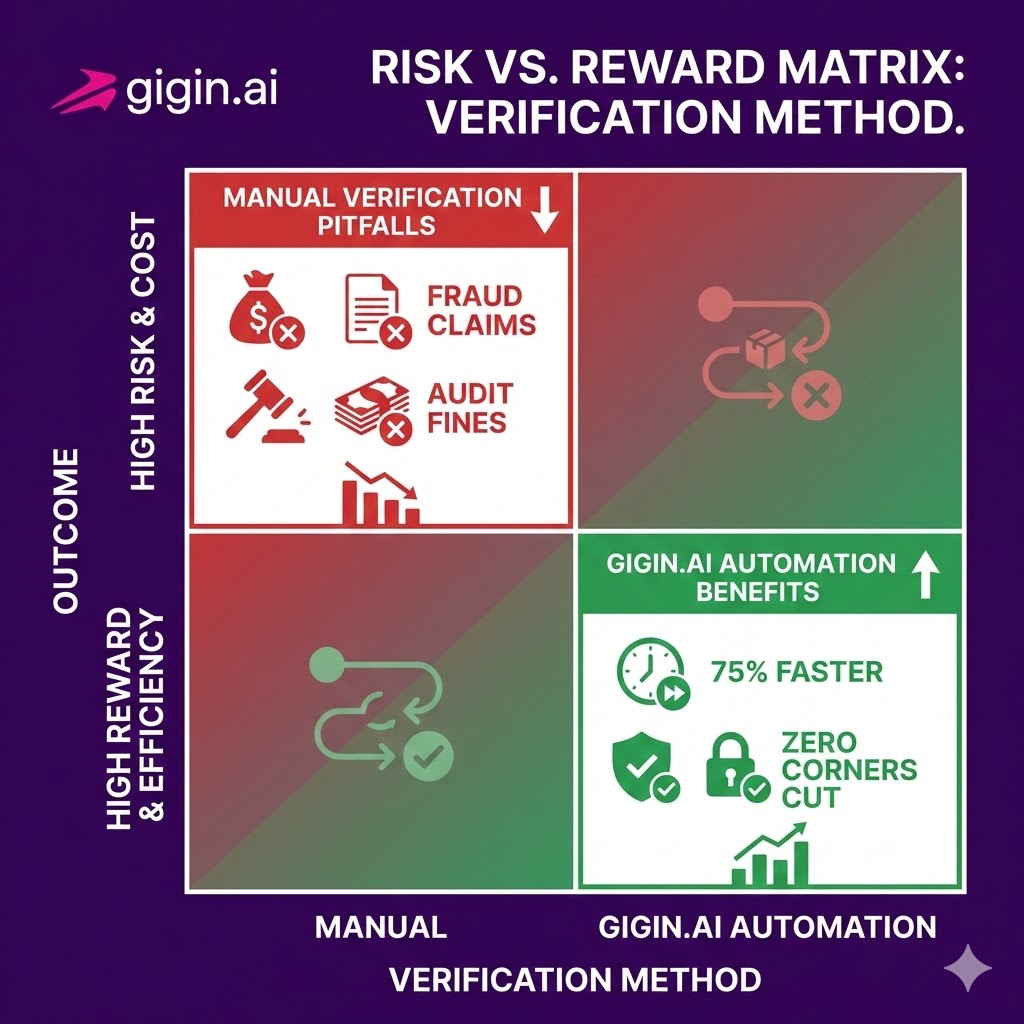
Stay compliant with India’s evolving verification and data protection laws without slowing down hiring. Gigin AI automates agent verification, consent capture, audit logs, and compliant background checks—all in one platform. Book a demo with Gigin AI and see how compliant onboarding can also be fast.
