
Designing Agents With Goals, Tools, and Guardrails

A lot of agentic software still behaves as though instruction alone is enough.
Give the model a role. Tell it what to do. Add some tool access. Hope the rest works out.
That may be acceptable for experimentation. It is weak for products.
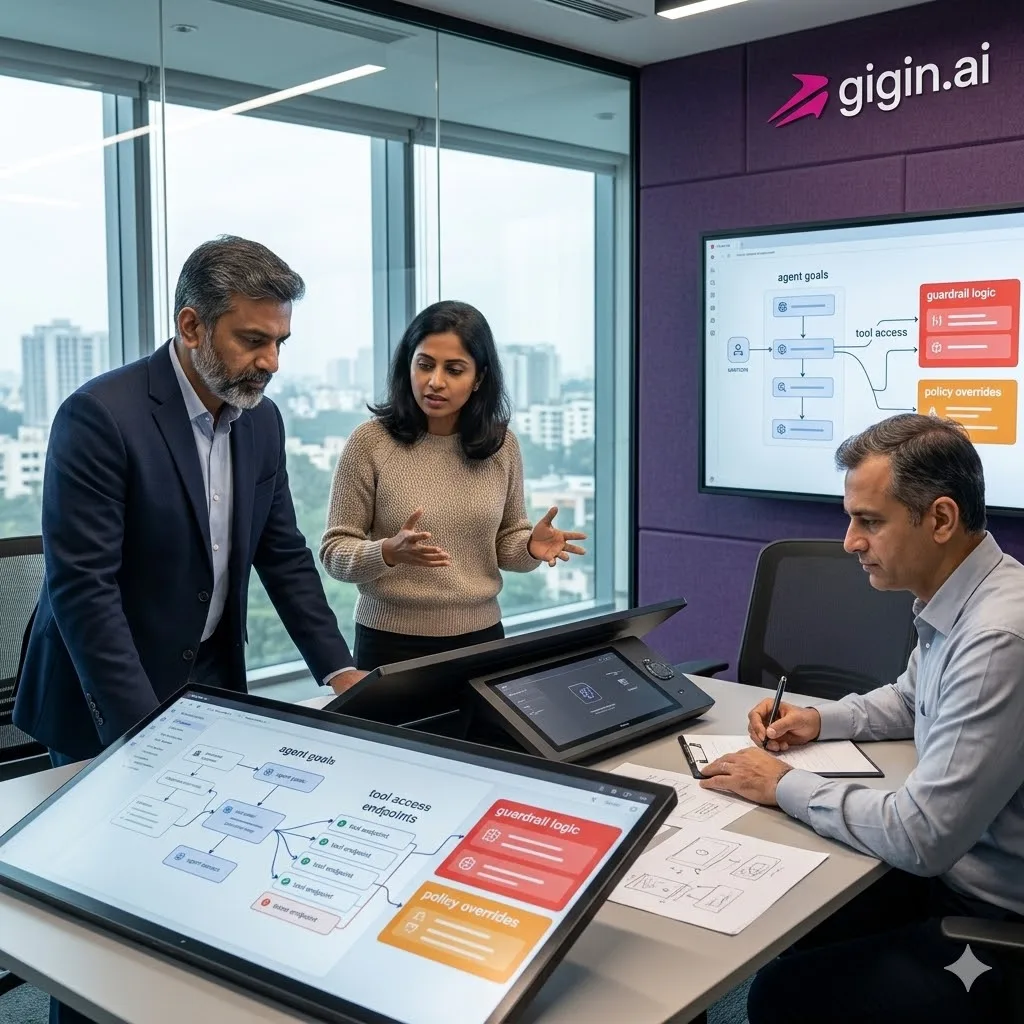
Serious agent systems need at least three things designed explicitly: goals, tools, and guardrails.
Goals matter because vague agents create vague products. A system told only to “help with hiring” has too much ambiguity to be reliably governed. Tools matter because model intelligence without operational reach is mostly text generation. Guardrails matter because once a system can act, it can also misact. That is why current official guidance is putting increasing weight on safe and governed execution. OpenAI’s guardrails guidance says guardrails help agents behave safely, consistently, and within intended boundaries, while its safety documentation warns that multi-agent workflows introduce risks such as prompt injection and unsafe tool use. NIST’s AI RMF and Generative AI Profile make the broader point that organizations should incorporate trustworthiness considerations into the design, development, use, and evaluation of AI systems. (OpenAI Developers)
This is why the strongest agent products will not be the freest. They will be the best governed.
That matters a great deal in hiring, where candidate movement, trust, workflow timing, and human judgment all carry business consequences. A system that generates clever suggestions is useful. A system that takes actions inside a workflow without clear boundaries can quickly become risky. Good design is not about maximizing autonomy at all times. It is about making sure the right actions happen under the right conditions with the right controls around them.
This is one reason Gigin’s technical direction is compelling. Publicly, the right way to say it is simple: Gigin is building toward a more governed, workflow-native hiring system where intelligent assistance operates inside clear product boundaries rather than outside them. That is a stronger position than treating AI as a free-floating assistant. It suggests the company understands that useful intelligence in enterprise software is inseparable from operational design.
There is also a practical engineering reason for this. OpenAI’s current guidance for production agents emphasizes starting with evals, meeting the accuracy target, and then optimizing for other trade-offs. That sequence only works when the system has clearer objectives and bounded action surfaces. In other words, governance is not just about safety. It is also about product quality. (OpenAI CDN)
The market will gradually learn this lesson the hard way. Unbounded assistants will create attention. Governed agents will create durable trust.
And in hiring, trust is not a nice-to-have.
It is part of the architecture.
That is why goals, tools, and guardrails are not implementation detail. They are the foundation of any serious agentic product.
