
Fragmented Workflows Create Invisible Labor Waste

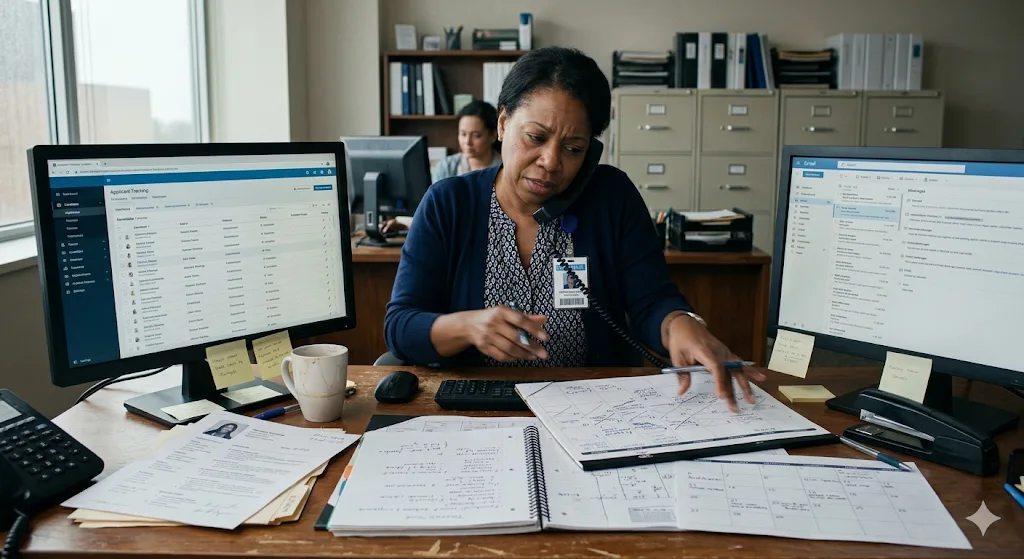
Healthcare recruiting teams usually know they are busy. What they do not always see clearly is how much of that busyness is created by fragmentation.
The clearest analogy comes from provider data and credentialing infrastructure. CAQH says it connects 1,000 health plans to over 4 million provider records, and its credentialing workflow is used by more than 2.5 million providers who actively enter and verify their information. CAQH’s own positioning makes the logic explicit: standardize and centralize data flow so people stop wasting time on redundant administrative work. (caqh.org)
Recruiting has the same problem, even if the market does not describe it in those terms.
Candidates get sourced in one place. Applications land somewhere else. Screening notes sit in email threads or recruiter documents. Schedules are coordinated through calendars, messages, and handoffs that are easy to miss. Credential-related information arrives later. Hiring managers want updates in one format, recruiters maintain another, and operations teams often build their own parallel tracking. Every individual piece may seem manageable. Together, they create invisible labor waste.
That waste is not harmless. It shows up in delayed responses, duplicate work, broken follow-up, missed context, lower recruiter productivity, and weaker candidate experience. More importantly, it steals attention from the work that actually requires human judgment. Instead of evaluating fit, aligning with managers, and moving quality decisions forward, recruiting teams end up functioning as manual integrators between disconnected systems.
In healthcare, that inefficiency is especially expensive because the system is already under staffing pressure. Every avoidable administrative step keeps vacancies open longer, keeps managers overloaded longer, and keeps candidates waiting longer. Fragmentation turns into cost without ever announcing itself as a cost center.
That is why connected workflow matters so much. It is not just a software preference. It is a labor-efficiency strategy.
This is also one of the clearest entry points for Gigin.Health. The public site is very explicitly framed around an ATS plus agentic suite rather than a single-feature tool. It positions Gia as helping with sourcing, shortlisting, scheduling, and workflow support, while the broader system connects application through onboarding. That matters because what healthcare recruiting needs is not another isolated point solution. It needs fewer broken transitions and less human effort spent stitching the process together. (caqh.org)
The healthcare recruitment community should become more disciplined about this. A hiring workflow can look active while quietly wasting enormous effort. That waste rarely shows up as a line item, but it shows up everywhere else: cycle time, recruiter fatigue, manager frustration, and candidate drop-off.
The organizations that reduce fragmentation will not just feel more organized. They will recover meaningful capacity from a system that has been leaking it for years.
Healthcare organizations and staffing teams looking to reduce hiring waste and improve workflow continuity can explore Gigin.Health via gigin.si or write to info@gigin.ai.
Further reading
- The Hidden Cost of a Fragmented HR Stack — HR Cloud
- UK recruiters lose two days per hire to admin, report finds — People Management (CIPD)
- The Credentialing and Enrollment Bottleneck: Nothing Moves Until the Provider Is Ready — Hospitalogy
- 61% of recruiting teams run three or more tools: a framework for when to consolidate — HR Tech Institute
More from Gigin
- Healthcare Does Not Need More Hiring Tools. It Needs One Connected Workflow.
- Credentialing Should Move Upstream, Not Wait at the End
- Administrative Burden Has Become a Staffing Problem
- I Tracked Where My Recruiters' Hours Actually Went. The Answer Changed How I Think About Hiring Forever.
- Your Recruiters Are Spending 40% of Their Time on Candidates Who Will Never Get Hired
