
Healthcare Does Not Need More Hiring Tools. It Needs One Connected Workflow.

There is a point at which adding more technology stops solving problems and starts creating them.
Healthcare recruiting is close to that point. The American Hospital Association’s 2026 Workforce Scan highlights what leading organizations are now doing: redesigning staffing models and workflow with team-based approaches, building the foundation for AI to deliver value, and rethinking roles and organizational design rather than just layering on more disconnected solutions. (aha.org)
That is a meaningful shift. It suggests the market is slowly recognizing that the problem is not simply lack of technology. It is lack of coherence.
Most healthcare hiring systems today are still assembled as a chain of tools and handoffs. A sourcing system feeds an ATS. A scheduler sits elsewhere. Candidate communication may happen outside both. Readiness, trust, and onboarding signals are often downstream or parallel. The result is a workflow that looks digital on the surface but still behaves manually underneath. People spend time repairing transitions, not just making decisions.
That matters because healthcare is one of the least forgiving environments for fragmented hiring design. Roles are urgent. Teams are lean. Stakeholders are busy. Readiness matters. Candidate drop-off is costly. When the workflow is broken into too many systems, recruiting becomes a coordination exercise disguised as a talent function.
The better answer is not one more niche layer. It is one connected workflow.
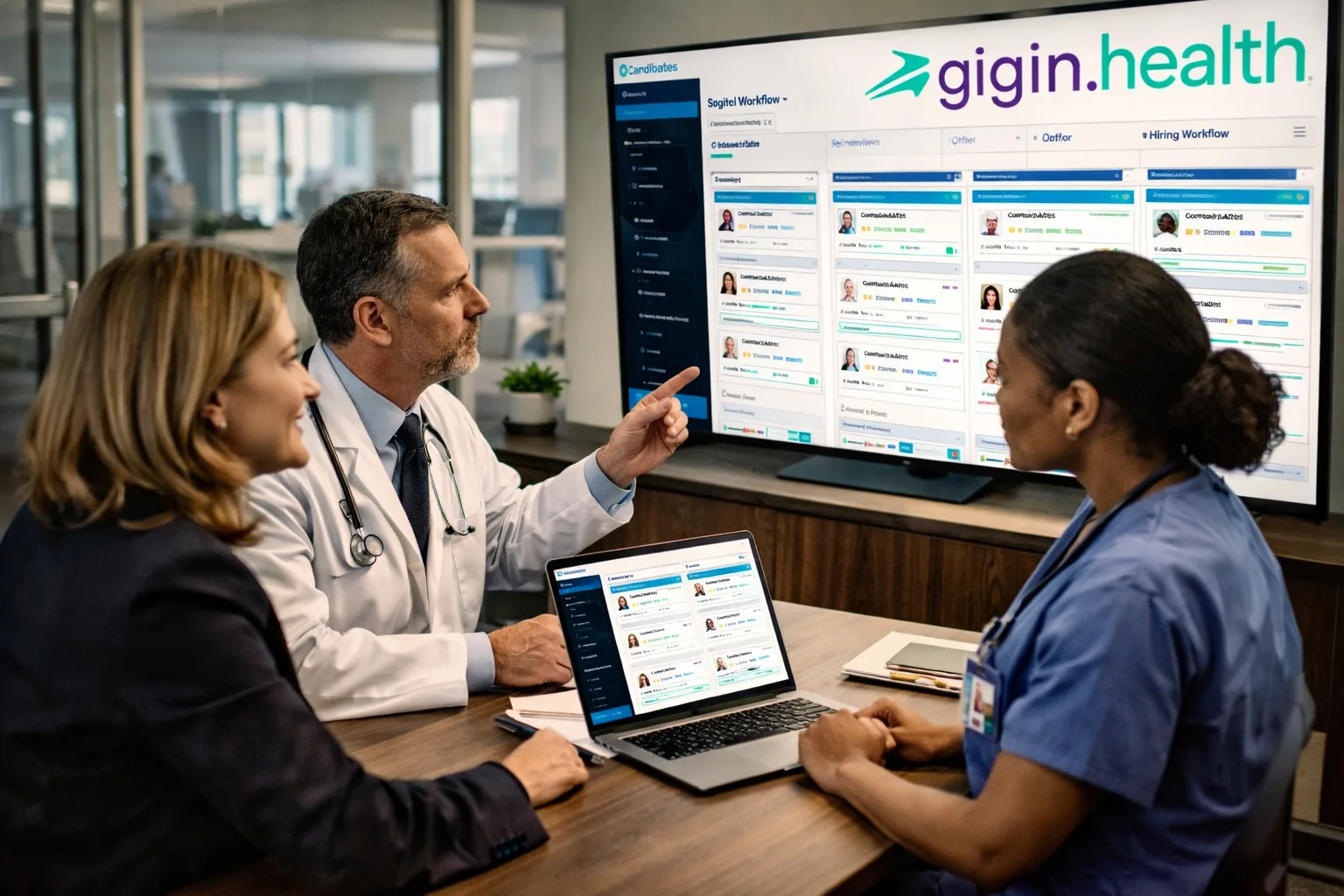
That is exactly why Gigin.Health is strategically relevant. Its public positioning is built around a healthcare ATS plus agentic suite rather than a collection of isolated tools. The site emphasizes one dashboard, application-to-onboarding flow, Gia as the AI recruiter, and healthcare-specific workflow support for candidate movement, scheduling, and credential-check processes. That is the right direction for this market because what healthcare needs is not more software surface area. It needs fewer broken handoffs. (aha.org)
The recruitment community should be more forceful about this distinction. A hiring process can be “digitized” and still be deeply inefficient if it remains fragmented. A connected workflow is not a cosmetic improvement. It changes how much recruiter time is lost, how quickly candidates move, how much visibility managers have, and how often the system stalls for avoidable reasons.
Healthcare does not need more hiring tools. It needs a more unified operating model for hiring.
The organizations that understand that will stop trying to optimize each stage in isolation and start building workflows that actually behave like systems.
Healthcare organizations and staffing teams looking to reduce hiring fragmentation and move toward a more connected model can explore Gigin.Health via gigin.si or write to info@gigin.ai.
Further reading
- 61% of recruiting teams run three or more tools: a framework for when to consolidate — HR Tech Institute
- The Hidden Cost of a Fragmented HR Stack — HR Cloud
- The Credentialing and Enrollment Bottleneck: Nothing Moves Until the Provider Is Ready — Hospitalogy
More from Gigin
- Fragmented Workflows Create Invisible Labor Waste
- Credentialing Should Move Upstream, Not Wait at the End
- What Gigin Is Really Building: A Natively Integrated Hiring Operating System
- Why Source-of-Truth Matters More Than Feature Count
- Healthcare Hiring Is No Longer a Support Function. It Is Infrastructure.
