
The Healthcare Team Mix Is Changing Faster Than Hiring Systems Are

One of the easiest mistakes in healthcare workforce strategy is assuming that the future will look like a larger version of the past.
The labor market is already telling us otherwise. The Bureau of Labor Statistics projects that employment of nurse anesthetists, nurse midwives, and nurse practitioners will grow 35% from 2024 to 2034, much faster than average. At the same time, the AAMC says the United States could face a physician shortage of up to 86,000 physicians by 2036. Taken together, those two signals point in the same direction: healthcare is moving toward a workforce model that depends more heavily on expanded advanced-practice roles, more flexible care teams, and more dynamic role mix than many hiring systems were built to support. (Bureau of Labor Statistics)
That matters because recruiting models tend to lag care-delivery models. Many organizations still hire as if the job were simply to fill a familiar req with a familiar process. But when workforce composition itself is changing, the hiring system has to become more adaptive. It has to support multiple role types, different evaluation rhythms, and a more fluid view of how care coverage is built. Otherwise, employers end up forcing a changing labor market through a workflow that was designed for a more static one. (Bureau of Labor Statistics)
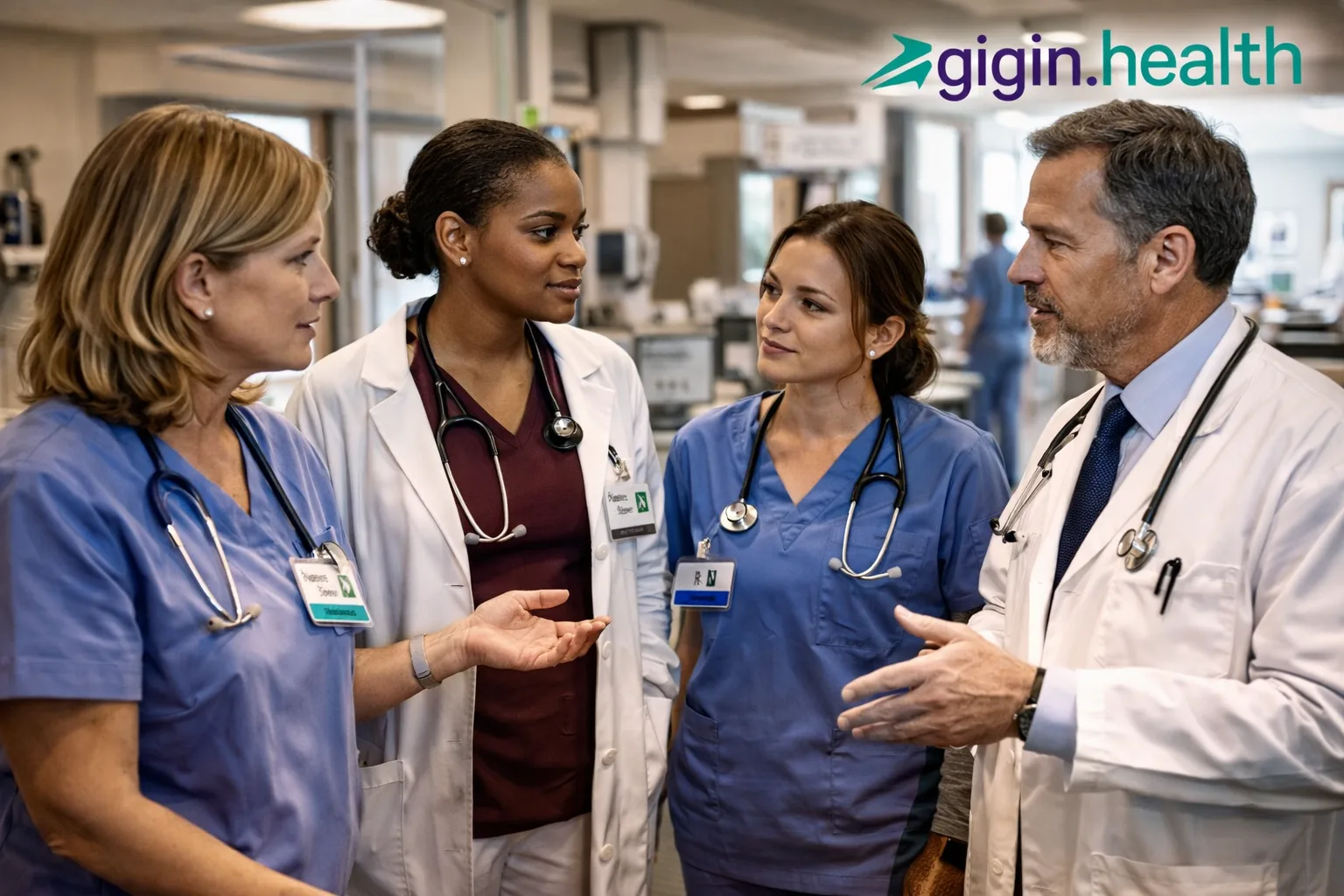
This is not only a physician-versus-APP story. It is a broader systems story. As organizations rely more on care teams that blend physicians, nurse practitioners, physician assistants, nurses, and support staff in different ways, recruiting has to become more than a requisition engine. It has to become a workforce-orchestration function. That means better visibility across pipelines, faster movement across stages, and less dependency on manual coordination each time a different role type enters the process.
That is one reason healthcare-specific workflow platforms are becoming more relevant. The public positioning of Gigin.Health is not just about sourcing candidates. It is about a healthcare ATS plus an agentic suite, with Gia supporting sourcing, shortlisting, and scheduling, while the broader workflow connects application to onboarding in one system. The site also emphasizes predictive staffing insight and role-suitability support, which is particularly relevant in a market where employers are hiring into a changing care-team structure, not just into static job descriptions. (gigin.health)
The broader point is that the labor market is not only telling healthcare that demand is rising. It is also telling healthcare that the shape of work is shifting. Hiring systems that remain rigid will feel slower and less useful every year. Hiring systems that become more connected, more role-aware, and less administratively brittle will help organizations adapt with less friction.
The future of healthcare recruiting will not belong to employers who simply fill more openings. It will belong to those who build hiring infrastructure around the workforce they are actually moving toward.
Healthcare organizations and staffing teams adapting to a changing clinical workforce mix can explore Gigin.Health via gigin.si or write to info@gigin.ai.
Further reading
- Nurse Practitioners Remain the Fastest-Growing Occupation (2nd consecutive year) — NurseJournal.org
- AAMC Report Predicts Significant Physician Shortage by 2036 — Healthcare Innovation (covering the AAMC report)
- Nurse Practitioner vs. Physician Assistant: Career Comparison — NurseJournal.org
More from Gigin
- Healthcare Hiring Is No Longer a Support Function. It Is Infrastructure.
- Physician Hiring Gets Harder as America Ages
- The Fastest-Growing Roles Are Telling Us Where Healthcare Is Going
- The Frontline Roles We Underrate Are the Ones Holding the System Together
- Recruiter Headcount Is Not Keeping Pace With Hiring Pressure
