
The Fastest-Growing Roles Are Telling Us Where Healthcare Is Going

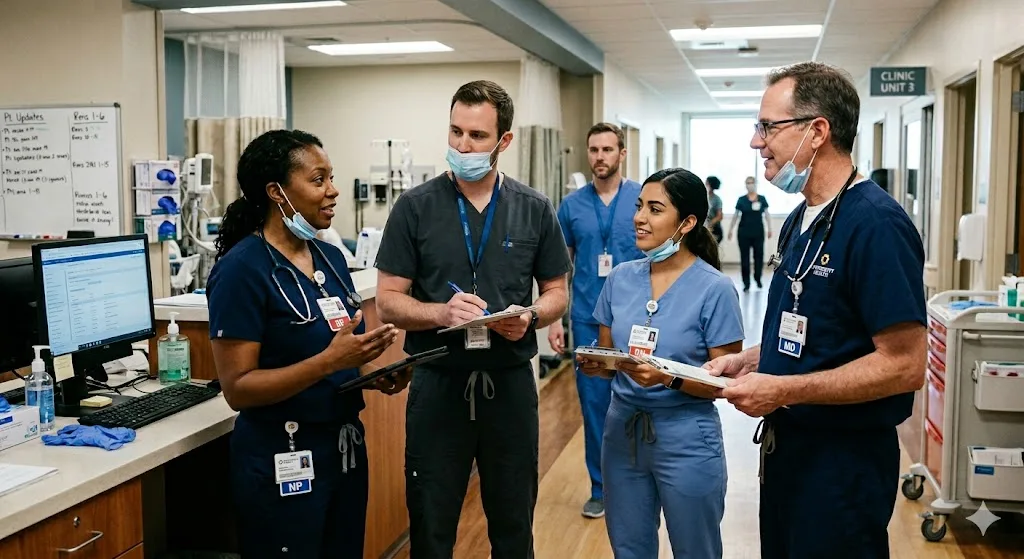
If you want to understand the future of healthcare hiring, do not start with the org chart most systems were built around. Start with the roles that are expanding fastest.
The Bureau of Labor Statistics projects that employment of nurse anesthetists, nurse midwives, and nurse practitioners will grow 35% from 2024 to 2034, far faster than the average for all occupations. That is not a small workforce signal. It tells us that the healthcare system is being pushed toward a different delivery model—one that relies more heavily on advanced-practice roles, more distributed clinical capability, and more flexible team composition than many hiring systems were originally designed to support. (Bureau of Labor Statistics)
That matters because recruiting models often lag care models.
Many organizations still hire as if the future will be a larger version of the past: more of the same roles, through roughly the same processes, with slightly more urgency attached. But the market is already telling us something different. The future workforce will not be built only around one clinician type or one traditional chain of care delivery. It will be built around a broader mix of practitioners, more dynamic care teams, and a stronger dependence on role fluidity, especially where physician supply is constrained and patient demand continues to rise. The hiring system has to keep up with that shift. (Bureau of Labor Statistics)
This is where the recruitment community should become more strategically ambitious. The old model of talent acquisition treats each open role like a separate transaction. The emerging model needs to treat workforce design itself as part of the hiring challenge. If nurse practitioners, advanced-practice clinicians, and mixed care teams are becoming more central to how healthcare will operate, then recruiting must become better at supporting multidisciplinary hiring, role-specific evaluation, and smoother movement across a more varied set of workflows.
That is not easy to do inside fragmented systems.
When candidate screening lives in one place, coordination in another, hiring-manager review in another, and readiness or onboarding signals elsewhere, the recruiting engine becomes too slow for a workforce model that is getting more complex. The problem is not only speed. It is that the system is trying to manage a changing labor structure through outdated workflow logic.
That is one reason the emergence of healthcare-specific platforms like Gigin.Health is strategically relevant. Gigin.Health is not being positioned as a generic HR-tech layer. It is being positioned as a healthcare ATS plus agentic suite, with Gia as an AI recruiter helping across screening, matching, scheduling, and candidate movement, and a workflow designed to connect application through onboarding. That type of infrastructure matters more in a market where role mix is shifting and teams need more operational coherence, not more software fragmentation. The site also emphasizes healthcare-specific workflow support, predictive staffing insight, and publicly claims outcomes such as 5x faster hiring and under-1-second matching. (Bureau of Labor Statistics)
The broader lesson is simple: the fastest-growing roles are not just labor statistics. They are signals about the future shape of care.
Healthcare organizations that pay attention to those signals early will build hiring systems around the workforce they are actually moving toward, not the one they are nostalgically assuming will remain intact. That means more flexible workflow design, more recruiter leverage, and a stronger ability to manage complexity without slowing down.
The future of healthcare hiring will belong to organizations that understand workforce evolution before it fully arrives.
Healthcare organizations and staffing teams adapting to a changing clinical workforce mix can explore Gigin.Health via gigin.si or write to info@gigin.ai.
Further reading
- Nurse Practitioners Remain The Fastest-Growing Occupation — NurseJournal.org
- AANP Spotlights Five Critical Health Care Trends to Watch — American Association of Nurse Practitioners (AANP)
More from Gigin
- The Healthcare Team Mix Is Changing Faster Than Hiring Systems Are
- Physician Hiring Gets Harder as America Ages
- The Frontline Roles We Underrate Are the Ones Holding the System Together
- Healthcare Does Not Need More Hiring Tools. It Needs One Connected Workflow.
- Workforce Is No Longer Just an HR Budget Line. It Is an Operating Strategy.
