
Context Engineering Is the New Prompt Engineering

For a while, the AI industry treated prompt engineering as the main craft.
That made sense in the early phase. When most systems were single-turn or lightly interactive, better prompts often produced noticeably better outcomes. But as products have become more agentic, more stateful, and more workflow-dependent, the center of gravity has shifted. Anthropic now describes context engineering as the more important emerging discipline and calls context a critical but finite resource for agents. That is a major shift in emphasis. It means the quality of an AI system now depends less on one clever instruction and more on how context is selected, structured, refreshed, and passed across steps. (Anthropic)
That is especially relevant in hiring.
Hiring is not a one-turn task. A role evolves. Candidate relevance changes. Prior actions matter. Trust signals accumulate. Interview outcomes reshape what should happen next. If the system keeps treating each interaction like a fresh start, it will feel superficially intelligent but structurally forgetful. That is why context engineering matters more than prompt engineering in production hiring systems. The product has to know what matters now, what mattered before, and what should carry forward. Anthropic’s earlier work on Contextual Retrieval makes this point even more concretely: by improving how context is prepared and retrieved, failed retrievals were reduced by 49%, and by 67% when combined with reranking. That is not a prompt trick. That is context architecture. (Anthropic)
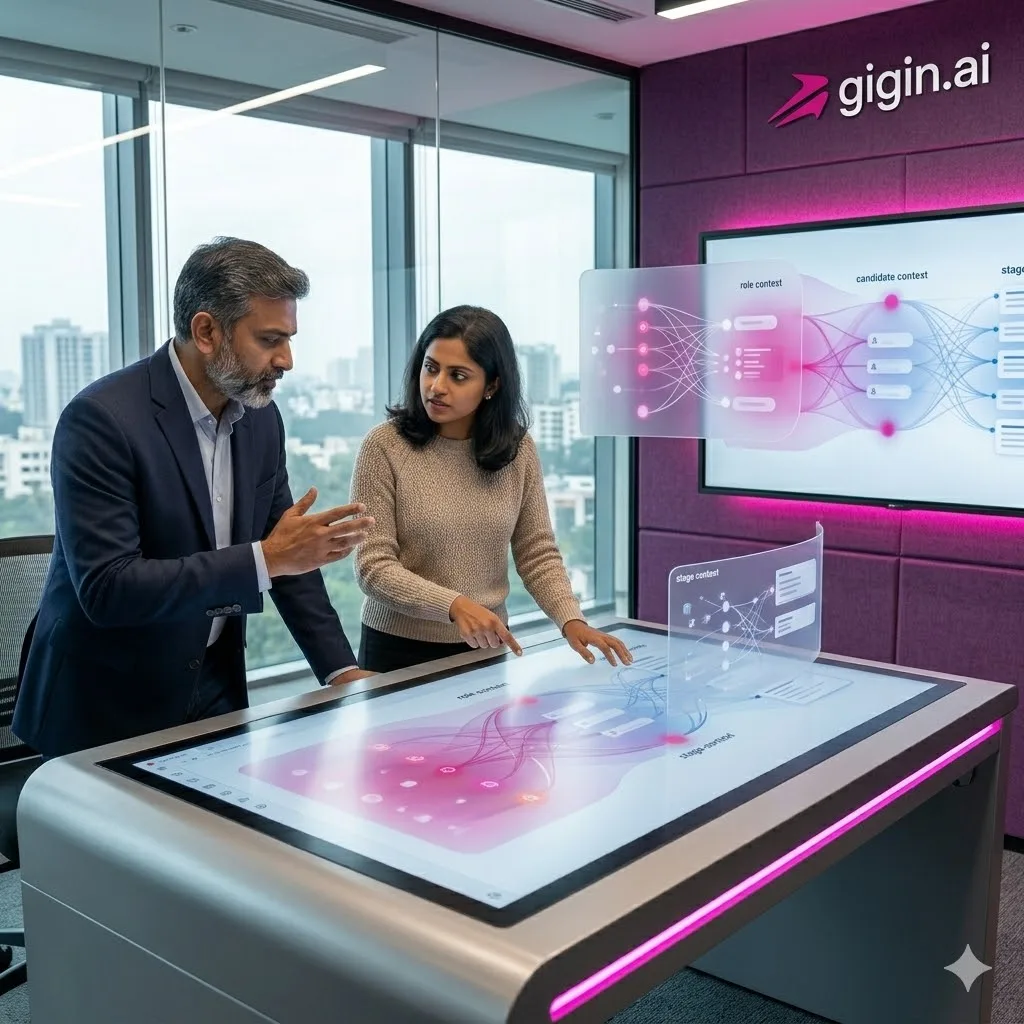
This is one of the most important ways to understand Gigin’s technical direction without needing to reveal internal implementation. Gigin is not trying to build a hiring product that simply gives good one-off answers. It is moving toward a hiring environment that becomes more useful as workflow context accumulates. That is a stronger and more durable design principle. A recruiter should not have to keep restating the process to the system. The system should progressively understand more of the role, the movement, the priorities, and the likely next actions because it is designed to carry context more intelligently across the workflow.
The market will slowly stop rewarding prompt cleverness on its own. It will start rewarding products that manage context well enough to feel reliable, stateful, and progressively relevant.
That is why context engineering is the new prompt engineering.
And it is one of the most important conceptual shifts builders in hiring should understand right now.
Further reading
- Context Engineering: A Practical Guide for AI Agents — Sourcegraph
