
What Gigin Is Really Building: A Natively Integrated Hiring Operating System

At some point, every category reaches a moment where feature language stops being enough.
Hiring software is approaching that moment now.
The reason is visible across the wider AI ecosystem. OpenAI has moved the conversation toward models, tools, memory/state, and orchestration. Anthropic is emphasizing context engineering and MCP. Google is investing in code-first multi-agent development and A2A interoperability. Microsoft is framing products like Work IQ around data, memory, and inference. NIST continues to push trustworthiness, governance, and evaluation as core system requirements for GenAI. Taken together, these are not isolated technical ideas. They point toward a new software model: products becoming more like coordinated operating systems and less like static applications with clever add-ons. (Anthropic)
That is the right way to understand what Gigin is really building.
Not a wrapper.
Not a narrow assistant.
Not a collection of disconnected hiring features with AI layered on top.
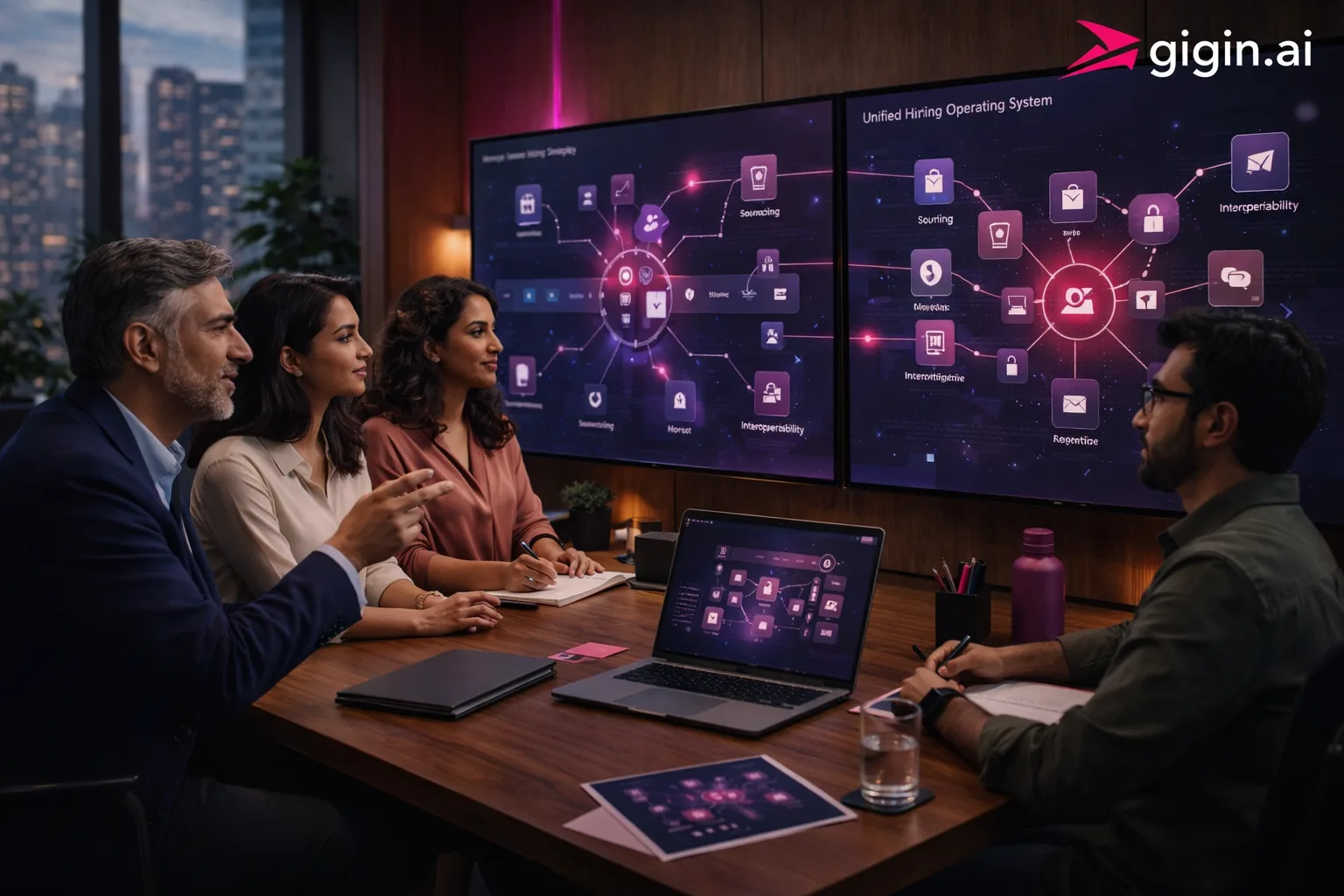
The more accurate description is that Gigin is building toward a natively integrated hiring operating system — a system where sourcing, workflow, trust, interoperability, context, and intelligent assistance are designed to reinforce each other instead of behaving like separate worlds. Publicly, that is the strongest way to talk about the company because it conveys ambition, architecture, and product maturity without exposing implementation detail that does not belong in public discourse.
It also aligns with the reality of where hiring software has to go. Buyers do not only need better prompts or nicer copilots. They need products that reduce fragmentation, preserve continuity, make trust easier to operationalize, and help people move through hiring with less manual stitching and more intelligent support. That is not a feature roadmap. It is a system design agenda. (Anthropic)
This is where Gigin’s technical supremacy should come through most clearly. The company should not overplay slogans. It should overperform on architecture. The right public signal is not “we have AI too.” The right signal is “we understand where the category is heading, and we are building with the structure, interoperability, and product discipline that direction requires.”
That is a much stronger message. It tells customers, partners, talent, and investors that Gigin is not chasing trend language. It is positioning itself for the software shape that is emerging right now in enterprise AI.
In the short term, the market may still reward feature-heavy storytelling. In the long term, it will reward systems that behave more like operating layers than feature bundles.
That is the category shift worth paying attention to.
And it is the category shift Gigin is positioned to help define.
Further reading
- SAP's AI-Native North Star Architecture: Technical Backbone of the Autonomous Enterprise — SAP News Center
- 4 Ways Fragmented HR Tech Stacks Undermine Your AI Strategy — ClearCompany
- The Moat Just Moved: Areas of Opportunity in AI-Native Software — Ardent Venture Partners (Medium)
More from Gigin
- The Future of Hiring Software Is Conversational, Context-Aware, and Agentic
- What Gigin Means by a Natively Integrated Hiring Stack
- Why Source-of-Truth Matters More Than Feature Count
- Most "AI Recruiters" Are Thin Layers. The Winning Stack Will Be Native.
- Why Orchestration Is the Real Product in Agentic Hiring
