
Staffing Stability Matters More Than Most Healthcare Systems Admit

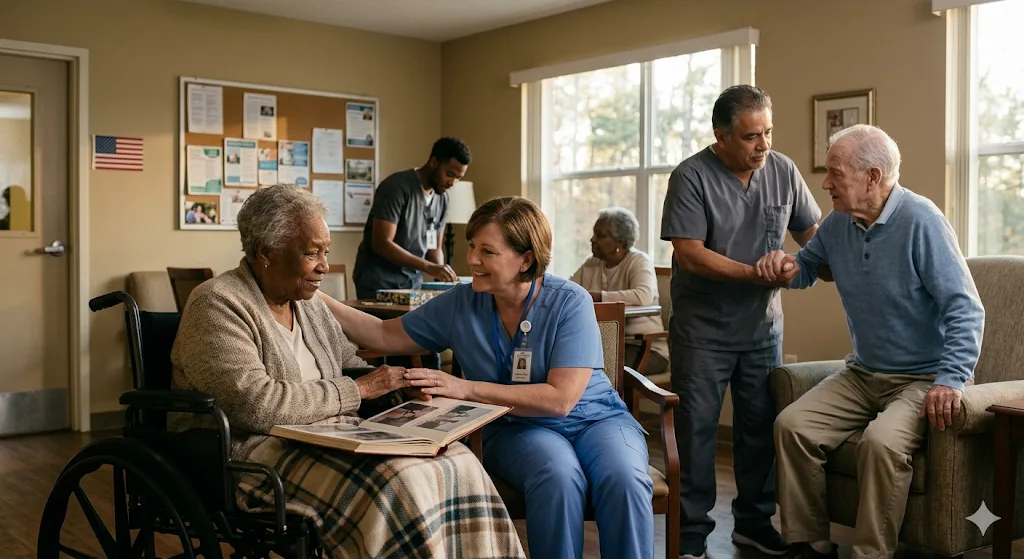
Healthcare leadership talks constantly about staffing levels. It talks less often, and less honestly, about staffing stability.
That distinction matters. A workforce can look “staffed” on paper and still behave like an unstable system in practice. A 2023 JAMA Internal Medicine study on U.S. nursing homes found that higher staff turnover was associated with significant increases in health-inspection citations and statistically significant decreases in quality measures. Earlier national research in Health Affairs reported mean annual turnover rates for nursing staff in nursing homes of about 128%, which shows just how extreme instability can become in long-term care settings. (JAMA Network)
That should reframe the hiring conversation.
The problem is not only whether roles are filled. The problem is whether a care environment can maintain enough continuity for routines, relationships, quality discipline, and institutional memory to hold together. In long-term care, post-acute settings, and other high-touch care environments, constant reset is expensive in ways that do not always show up neatly in hiring dashboards. It affects supervision, communication, consistency, and ultimately the experience of care itself. (JAMA Network)
This is why staffing stability deserves to be treated as a strategic workforce outcome rather than a downstream operational hope. When an organization hires into an unstable environment, the recruiting team is often forced into endless replacement cycles. The system starts rewarding motion instead of resilience. People are brought in, worked into a strained operating context, and then too often replaced before the value of the original hiring effort has had time to mature. The result is a workforce engine that never really compounds.
That is also why recruiting quality and workflow quality matter more than many employers assume. If the front end of hiring is fragmented, slow, and weakly coordinated, it tends to worsen instability rather than reduce it. Candidates enter with less clarity, managers operate under more pressure, onboarding starts from a rushed footing, and trust in the process erodes. A hiring system that only optimizes for speed without continuity is not actually helping solve the deeper workforce problem.
This is where Gigin.Health fits naturally into the conversation. Its public positioning is not that of a generic applicant tracker. It is positioned as a healthcare ATS plus agentic suite, with Gia supporting recruiting workflow across screening, scheduling, and movement, while the broader platform connects application to onboarding in one operational flow. In practical terms, that matters because staffing stability starts earlier than most organizations think. It starts in whether the system can move the right people through a cleaner, less chaotic, more consistent process from the beginning. (JAMA Network)
The broader lesson is one the healthcare recruitment community should state more directly: staffing stability is not a side effect of hiring. It is one of the main reasons hiring exists in the first place.
If the workforce engine keeps producing turnover-heavy outcomes, then the answer is not only more recruiting effort. It is better system design—better match, better movement, better coordination, and less preventable friction from the start.
Healthcare organizations and staffing teams looking to improve hiring continuity and reduce workforce instability can explore Gigin.Health via gigin.si or write to info@gigin.ai.
More from Gigin
- Retention Is a Recruiting Metric in Disguise
- First-Year Attrition Is Where Hiring ROI Leaks Away
- Healthcare Does Not Need More Hiring Tools. It Needs One Connected Workflow.
- Rural Healthcare Does Not Need More Hope. It Needs Better Workforce Operating Models.
- Burnout Is Not Just a Workforce Issue. It Is a Quality Issue.
