
The Future Is Recruiter-Led, AI-Amplified Hiring

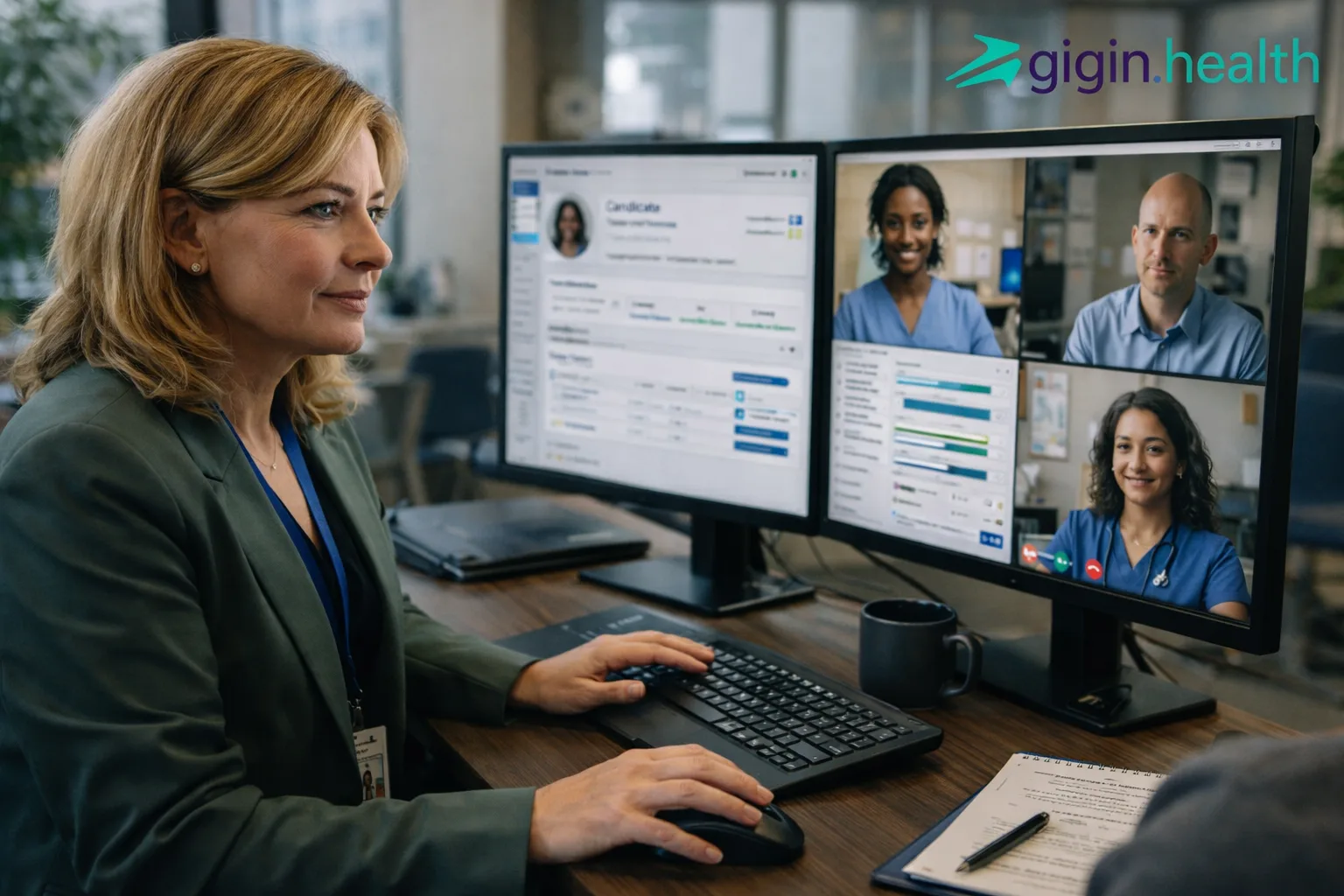
The market still frames AI in hiring with the wrong binary. It assumes the future must be either fully human and highly manual, or highly automated and less human. Healthcare should reject that framing.
The more credible path is already visible in other parts of the industry. Recent ambient-AI studies in medicine show that technology is most useful when it removes repetitive administrative work and gives skilled professionals more space to exercise judgment. In the 2025 JAMA Network Open study on ambient AI scribes, participants reported reduced burnout, lower cognitive task load, improved ability to give patients undivided attention, and less time documenting after hours. The lesson is not that clinicians became less important. The lesson is that the workflow made better use of them. (JAMA Network)
That is exactly the model healthcare recruiting should adopt.
Recruiters are still essential because hiring in healthcare is trust-heavy, readiness-heavy, and operationally consequential. Managers still need to judge fit. Recruiters still need to build alignment, move conversations forward, and interpret context that a system alone cannot fully own. But that does not mean those same professionals should spend disproportionate time on shortlisting mechanics, repetitive follow-up, scheduling friction, note summarization, and workflow repair. Those are the places where AI and automation can create real leverage. (JAMA Network)
That is why the future is best described as recruiter-led, AI-amplified hiring.
In that model, AI is not the decision-maker. It is the workflow multiplier. It helps reduce low-value process burden so recruiters can spend more time where human capability actually matters: candidate evaluation, stakeholder management, escalation, and final judgment. That is also a far better fit for healthcare’s operating culture, where accountability, trust, and visibility matter far more than abstract claims of autonomy. (aha.org)
This is where Gigin.Health is positioned in a way that aligns with the market’s likely direction. The site frames the product as a healthcare ATS plus an agentic suite, with Gia functioning as the AI recruiter across sourcing, shortlisting, scheduling, and hiring workflow support. But the broader story is still one of recruiter and team control: one dashboard, healthcare-specific workflow, and a connected process from application to onboarding. That is a more believable and more useful model than the idea that healthcare recruiting should become recruiter-less. (gigin.health)
The recruitment community should lean into that language. The future is not about removing professionals from hiring. It is about making professionals less trapped by the wrong kind of work.
That is the hiring model healthcare is most likely to trust, adopt, and scale.
Healthcare organizations and staffing teams exploring a more practical recruiter-led, AI-amplified workflow can explore Gigin.Health via gigin.si or write to info@gigin.ai.
