
The Next Hiring Edge Is Trust at Scale

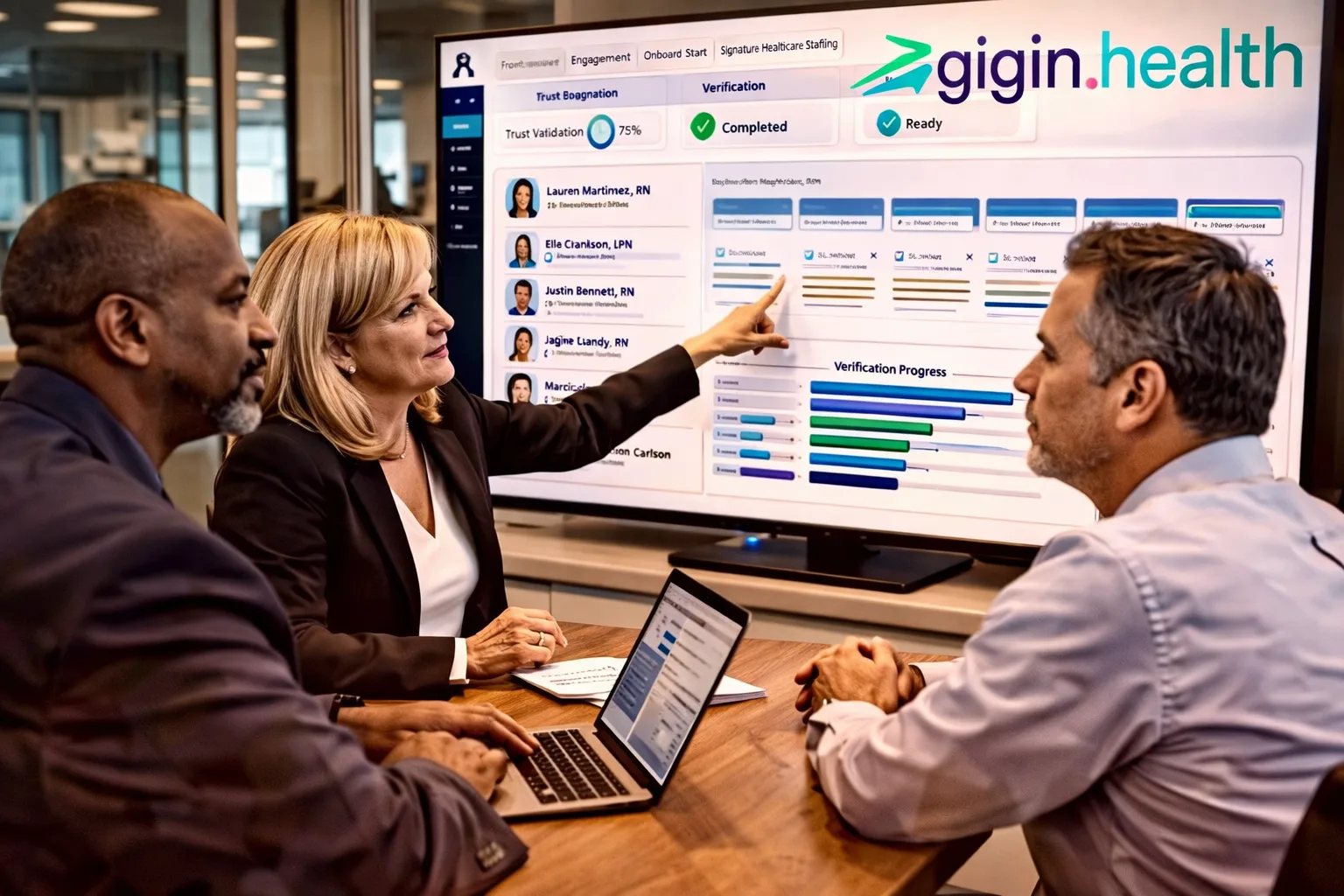
Healthcare has never been able to treat trust as an optional layer in hiring. What is changing now is that trust itself has become a scalability problem.
The old model assumed trust could be checked later, manually, or through fragmented downstream processes. That approach becomes less viable when hiring demand is high, candidate movement needs to be faster, and teams are already working inside overloaded workflows. In that environment, trust cannot remain a final-stage box to tick. It has to become part of the operating design of the hiring system itself. That is one reason the broader healthcare industry has invested so heavily in structured credentialing and provider-data infrastructure. CAQH says it connects 1,000 health plans to more than 4 million provider records, and that 2.5 million providers actively enter and verify their information through its platform. Its credentialing suite also embeds primary source verification using 500+ trusted sources. (caqh.org)
The lesson for healthcare recruitment is larger than credentialing alone. It is that trust scales only when it is built into the workflow. If organizations still rely on late-stage manual checks, disconnected systems, and fragmented readiness processes, they are effectively trying to move faster while preserving confidence with tools that were never designed to do both at once. That creates a predictable outcome: avoidable delays, reduced recruiter leverage, and more last-minute surprises than a pressure-filled labor market can comfortably absorb. (caqh.org)
This is especially important now because the sector is under structural growth pressure. The Bureau of Labor Statistics says healthcare occupations are projected to generate about 1.9 million openings per year on average from 2024 to 2034, and the wider healthcare and social assistance sector is projected to be the fastest-growing major industry segment. In a market expanding at that scale, the organizations that can move people through the hiring process with both speed and confidence will build a material advantage over those that continue to choose between the two. (Bureau of Labor Statistics)
That is where Gigin.Health fits naturally into the category direction. Its public positioning is not just about faster sourcing or a cleaner ATS experience. It is built around a healthcare ATS plus an agentic suite, with Gia helping with candidate movement, screening, and scheduling, while the broader workflow spans application to onboarding. The site also highlights healthcare-specific workflow support and automated credential-check elements. In practical terms, that is the kind of model the market increasingly needs: one where trust is not bolted on after the fact but handled as part of the system that moves people forward. (gigin.health)
The recruitment community should become more explicit about this. In healthcare, the next hiring edge is not only about finding candidates faster. It is about creating trust at scale without slowing the organization down.
The employers that solve that well will not just hire more efficiently. They will build a workforce engine that is both faster and more reliable, which in healthcare is a far more meaningful advantage than speed alone.
Healthcare organizations and staffing teams looking to improve trust, readiness, and workflow continuity can explore Gigin.Health via gigin.si or write to info@gigin.ai.
Further reading
- Key Credentialing Trends Shaping Healthcare in 2026 — HealthStream
- The Credentialing and Enrollment Bottleneck: Nothing Moves Until the Provider Is Ready — Hospitalogy
More from Gigin
- Healthcare Does Not Need More Hiring Tools. It Needs One Connected Workflow.
- Credentialing Should Move Upstream, Not Wait at the End
- Healthcare Is Ready for Clinical-Grade Hiring Infrastructure
- Healthcare Hiring Is No Longer a Support Function. It Is Infrastructure.
- Healthcare AI Adoption Will Be Won by Proof, Not Hype
