
What Gigin Means by a Natively Integrated Hiring Stack

The phrase “integrated platform” has been used so loosely in software that it often means very little.
In many products, “integration” really means adjacency. A few APIs connect two systems. A shared login makes the experience feel unified. A dashboard sits above multiple modules. But underneath, the user is still doing a lot of the integration work. They carry context between tools, reinterpret stage transitions, re-enter information, and manually repair broken continuity. That is not real integration. That is software leaning on people to behave like middleware.
The broader AI ecosystem is already moving beyond that model. OpenAI’s official guidance describes production agent systems as compositions of models, tools, state or memory, and orchestration, while Google’s Agent Development Kit is explicitly code-first and designed for production-ready agentic applications with greater flexibility and precise control. Anthropic’s Model Context Protocol also defines an open standard for secure, two-way connections between data sources and AI-powered tools. Put simply, the technical frontier is shifting from “AI on top of software” to “AI inside connected systems.” (OpenAI Developers)
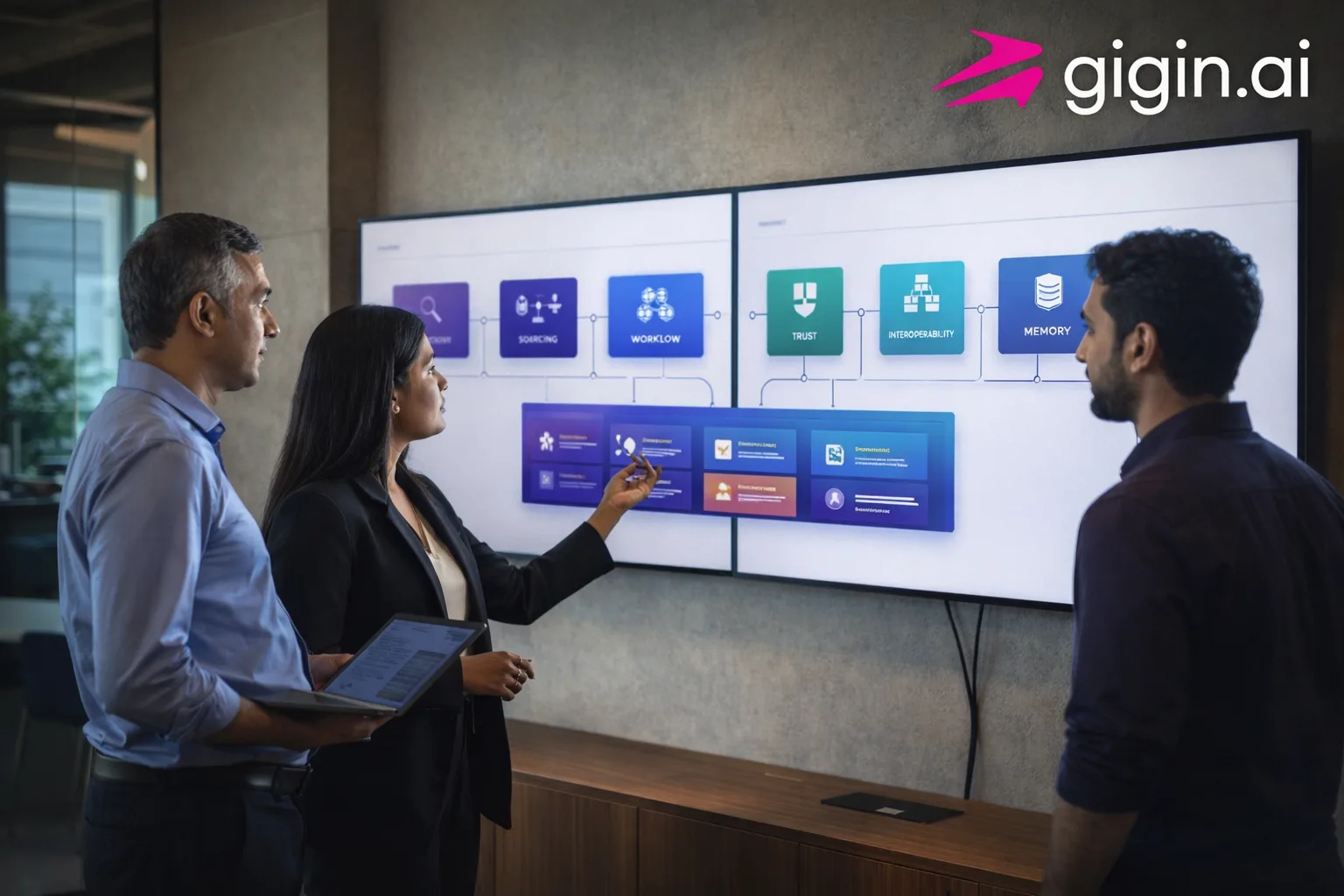
That is the context in which Gigin’s technical direction becomes important. When Gigin talks about a natively integrated hiring stack, it is not talking about a visual bundle of unrelated features. It is talking about a product philosophy: sourcing, workflow, trust, interoperability, and intelligent assistance should not feel like separate worlds pretending to cooperate. They should behave like one system. That is a much stronger architectural position because it reduces the number of times the user has to manually reconstruct what is happening between stages.
Why does that matter so much in hiring? Because hiring is a stateful process. A role evolves. Candidate quality changes. urgency shifts. trust requirements matter. stage movement compounds. If the system cannot preserve continuity, then every new step becomes a small reset. Those resets are what create recruiter fatigue, workflow friction, and hidden operating cost. A natively integrated stack reduces that by allowing the software to carry more of the process intelligence itself instead of forcing users to carry it in their heads.
This is one of the reasons Gigin’s technical narrative should stay focused on systems, not just features. The category will eventually stop rewarding products for simply adding AI moments to fragmented software. It will reward products that make the underlying workflow itself more coherent, more governable, and more context-aware. That is what “native integration” should mean in the AI era.
And that is the standard Gigin should continue to hold itself to.
Further reading
- Best-of-Breed vs. Integrated Suites: Finding the Right HR Tech Mix for 2026 — Zal.ai
- HCM Platform vs. Point Solutions — HiBob
- Why Your HR Tech Stack Should Integrate — eSkill
- Agent Development Kit: Making it easy to build multi-agent applications — Google Developers Blog
More from Gigin
- Why Source-of-Truth Matters More Than Feature Count
- Most "AI Recruiters" Are Thin Layers. The Winning Stack Will Be Native.
- Integrations Are Not a Badge. They Are an Architectural Decision.
- Why Protocol-Driven AI Will Beat Hardcoded Integrations
- What Gigin Is Really Building: A Natively Integrated Hiring Operating System
