
Why Orchestration Is the Real Product in Agentic Hiring

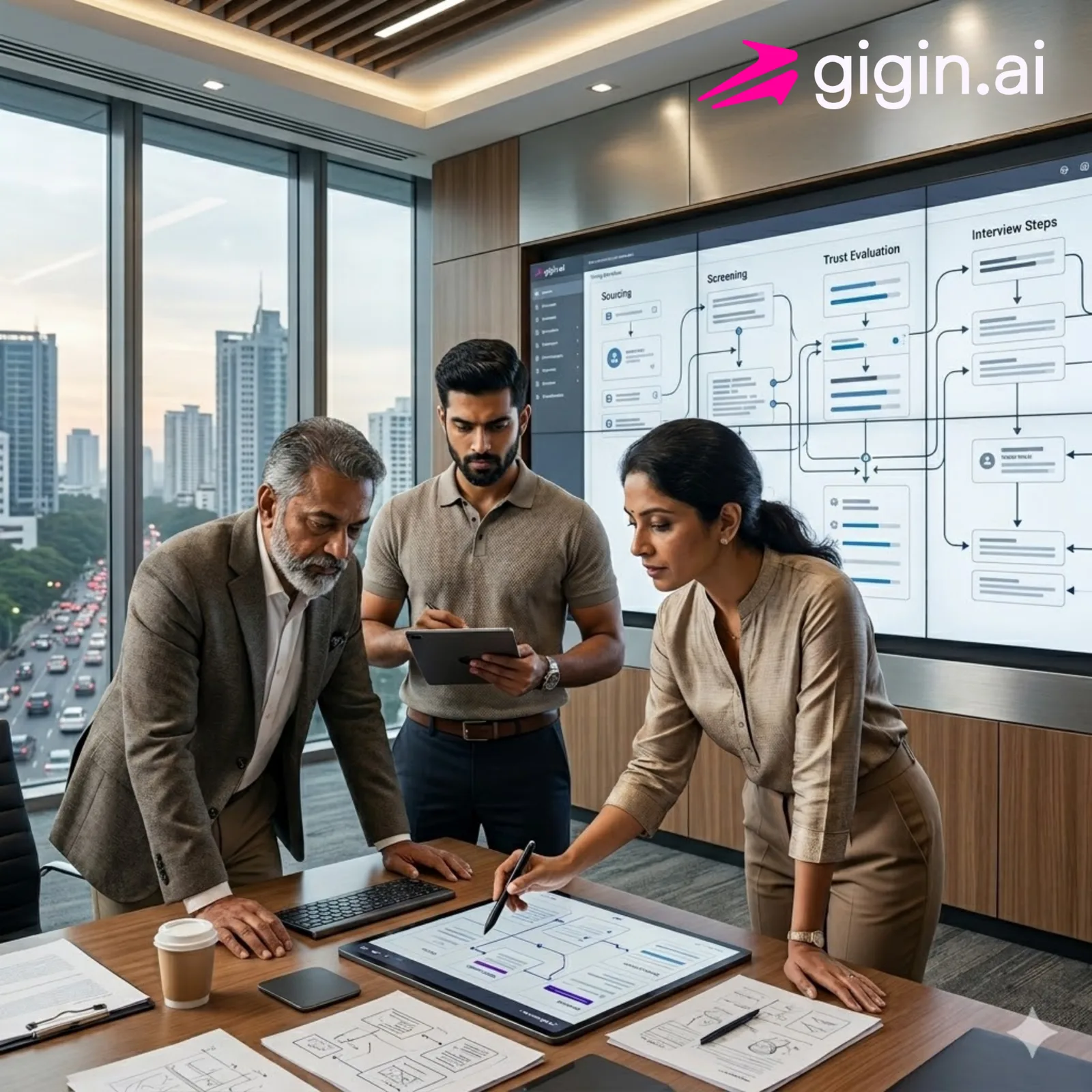
Most discussions about agentic software still focus too much on what the model can say and too little on what the system can govern.
That is the wrong emphasis.
In production systems, the most important technical problem is usually not the raw intelligence of the model. It is the orchestration layer: how the system decides what should happen next, which tool should be used, how context should move, when a human should intervene, and how different steps are governed so the workflow remains coherent instead of chaotic.
The official AI tooling ecosystem is already explicit about this. OpenAI defines orchestration as handling multiple steps, tool use, handoffs, guardrails, and context, essentially the logic that manages conversation and action flow across the system. Google’s ADK similarly emphasizes precise control over agent behavior and orchestration, alongside debugging and evaluation. Google’s A2A protocol takes the same idea one level higher by enabling agents to communicate securely, exchange information, and coordinate actions across enterprise environments, with support from 50+ technology partners at launch. (OpenAI Developers)
That is why orchestration is the real product in agentic hiring.
A sourcing assistant without orchestration is just a task performer.
A screening assistant without orchestration is just a task performer.
An interview assistant without orchestration is just a task performer.
What makes the system valuable is the logic that routes between them, decides what context should persist, and governs how actions move forward inside the hiring workflow. That is where the difference between “AI feature” and “AI operating layer” becomes real.
This is where Gigin’s architectural direction is strong. The company is not just trying to make isolated tasks smarter. It is moving toward a coordinated hiring environment where sourcing, workflow, trust, interoperability, and intelligent assistance can act as parts of one broader system. Publicly, that is the right level to speak about it. The more important point is not what individual components do. The more important point is that Gigin understands the real product challenge is not generating outputs — it is governing movement across the hiring process.
That is also what makes orchestration a moat. Many competitors can access strong models. Many can ship a prompt-based use case. Far fewer can make multi-step workflows behave well under real user pressure, role complexity, trust requirements, and integration variance. The companies that solve that will build stronger products than those that simply produce attractive single-step outputs.
The market will eventually understand this more clearly.
The visible AI layer gets attention.
The orchestration layer creates product quality.
And in agentic hiring, product quality is what will actually matter.
