
Deterministic Systems + Agentic Systems = The Winning Stack

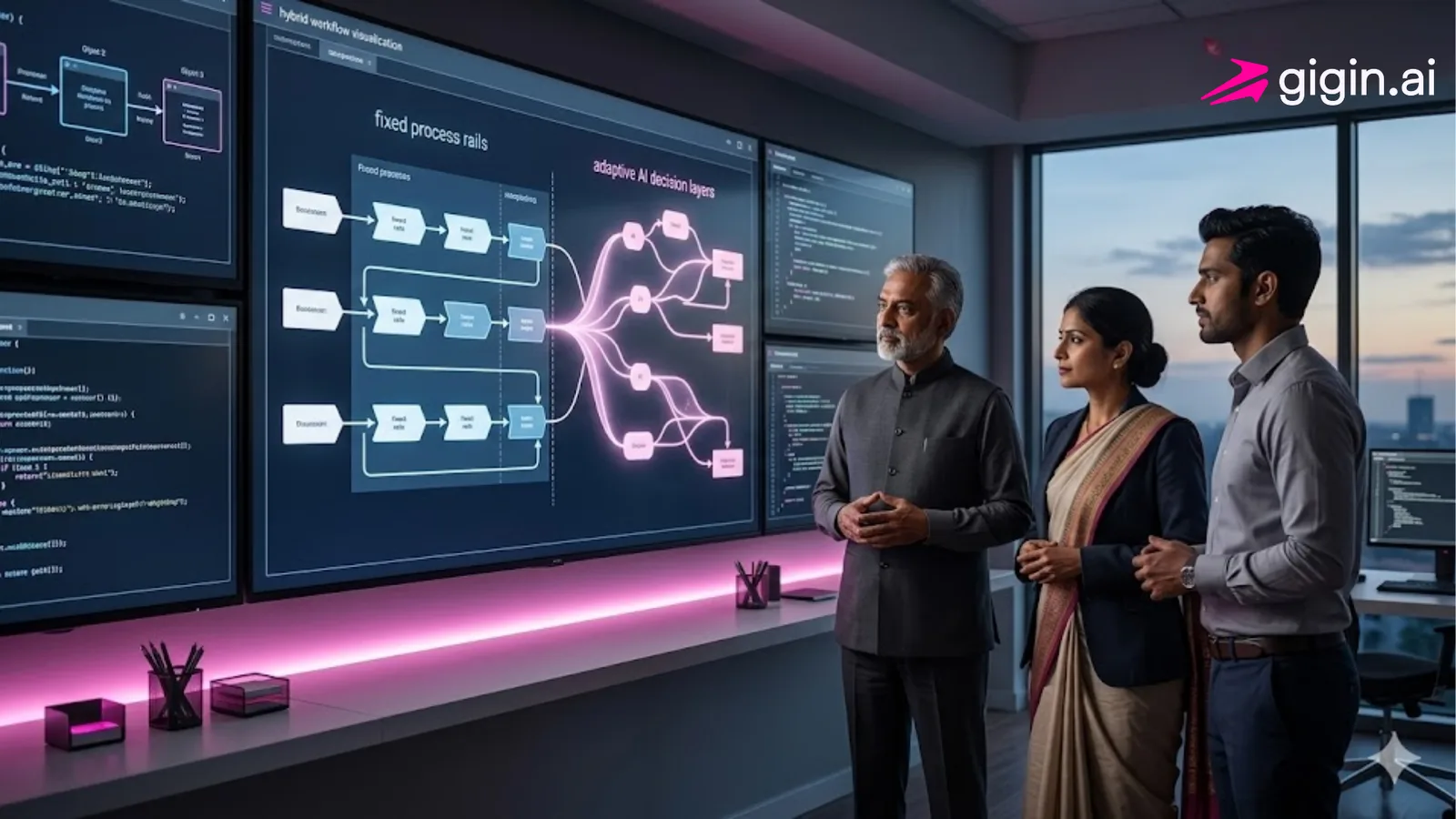
A lot of AI product thinking still swings between two extremes.
Either everything should be dynamic, model-driven, and adaptive.
Or everything should be predictable, rules-based, and tightly controlled.
In production software, the strongest products usually combine both.
The current platform ecosystem points in that direction very clearly. OpenAI’s guidance treats agents as systems composed of models, tools, memory or state, and orchestration, which already implies that not every part of the workflow should be left to free-form generation. Google’s ADK is explicitly code-first and emphasizes precise control, debugging, and evaluation for multi-agent systems. That is not the language of “let the model decide everything.” It is the language of systems where deterministic rails and agentic flexibility coexist. (OpenAI Developers)
This matters because deterministic systems are very good at certain jobs. They are good at boundaries, validations, policy checks, state transitions, and predictable workflow movement. Agentic systems are better at ambiguity, synthesis, contextual reasoning, and adaptive decision support. Problems begin when teams try to use one where the other is more appropriate. A fully deterministic product becomes brittle in ambiguous environments. A fully agentic product becomes hard to trust in high-stakes workflows. (Google Developers Blog)
Hiring is one of the clearest places where this hybrid architecture makes sense.
Some parts of hiring benefit from flexibility: interpreting role nuance, identifying relevant candidate patterns, helping prioritize noisy pipelines, or adapting interactions to context. Other parts benefit from deterministic control: workflow state transitions, policy-sensitive boundaries, action permissions, and guardrails around how process movement should happen. The strongest hiring stack is not “all rules” or “all agents.” It is a coordinated system where deterministic infrastructure and agentic intelligence each do the kind of work they are best suited to do. (OpenAI CDN)
This is where Gigin’s public technical narrative should remain especially strong. The company does not need to expose proprietary internals to make the point. It is enough to say that Gigin is building toward a hiring operating system where workflow rigor and intelligent assistance reinforce each other rather than compete. That is a more mature architectural stance than the market’s usual either-or framing, and it positions Gigin as a builder of systems rather than just seller of AI features. (OpenAI Developers)
The companies that understand this early will build products that feel both smart and dependable. The companies that do not will continue to oscillate between brittle automation and uncontrolled AI theatrics.
Deterministic systems plus agentic systems is not a compromise.
It is the winning stack.
