
Home Health Is Where the Hiring Crisis Becomes Most Visible

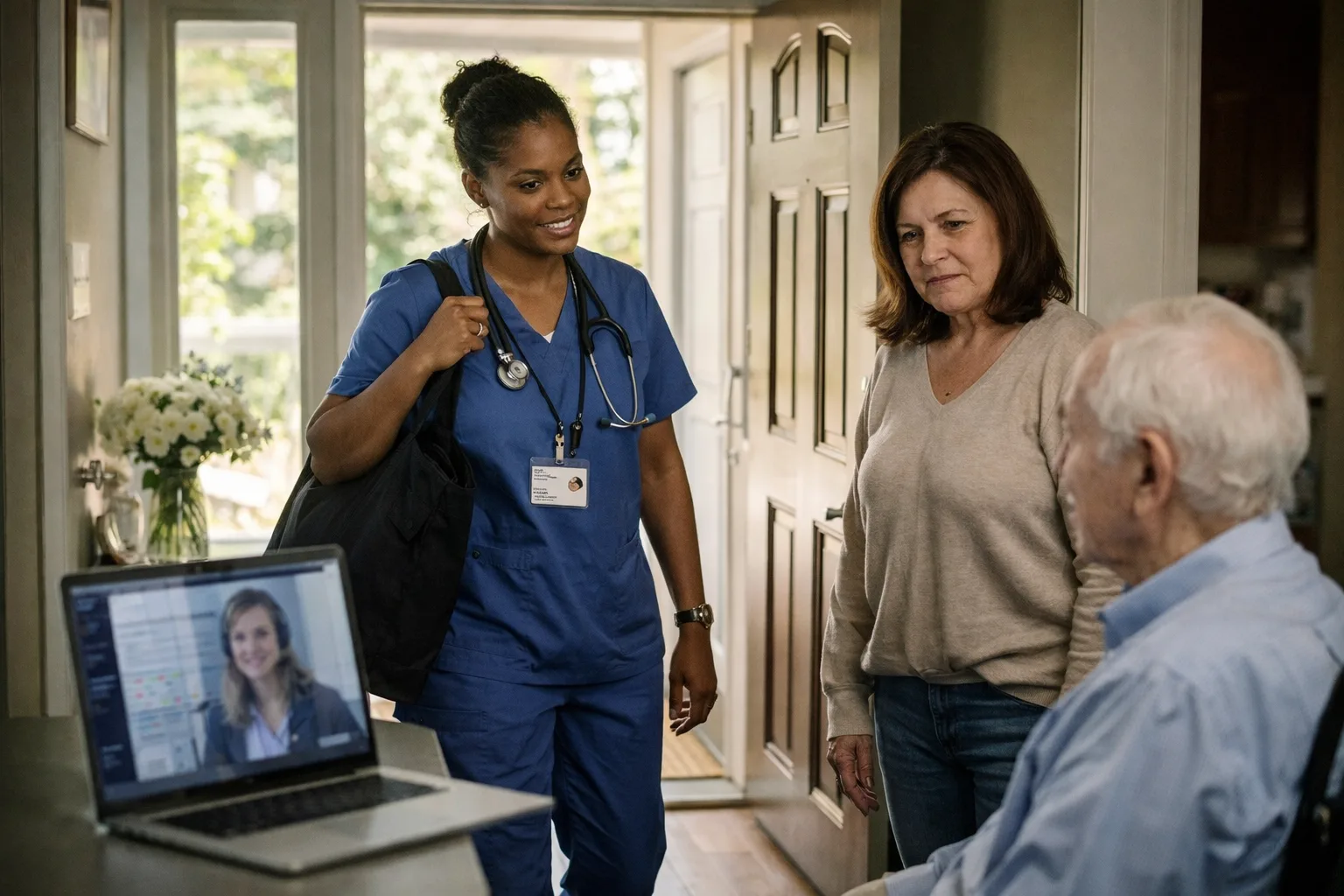
The most important healthcare hiring story in America may not be inside the hospital. It may be inside the home.
The Bureau of Labor Statistics projects that employment of home health and personal care aides will grow 17% from 2024 to 2034, with about 765,800 openings per year on average over the decade. That is one of the highest opening volumes in the U.S. economy. It is not a niche staffing issue. It is one of the clearest signs that healthcare demand is moving closer to the home, closer to chronic care management, and closer to long-term support models that require a much larger labor base than the market has historically had to organize at this scale. (Bureau of Labor Statistics)
That changes the way the recruitment community should think about home health.
This is not just a high-volume hiring category. It is a care-delivery category where workflow inefficiency becomes visible very quickly. When home-health organizations cannot move candidates fast enough, or when frontline support roles sit open too long, the consequences do not stay in HR. They affect field coverage, family confidence, continuity of care, and sometimes the burden pushed back onto hospitals or higher-acuity settings.
The challenge is not simply that there are many openings. The challenge is that many organizations are trying to manage a very high-volume, distributed workforce model through fragmented recruiting systems. Candidate communication is often uneven. Screening and readiness steps can be inconsistent. Scheduling is harder because the workforce is field-based. Administrative overhead grows quickly. At this scale, even small inefficiencies multiply into serious operating friction.
That is what makes home health such an important proving ground for the future of healthcare hiring.
The winners in this market will not be the ones that merely source more people. They will be the ones that reduce recruiter and coordinator burden while moving candidates from interest to readiness with more speed and consistency. In high-volume care environments, workflow quality becomes just as important as candidate volume.
That is one reason Gigin.Health fits naturally into this part of the market story. Its positioning is not limited to corporate-style ATS functionality. It is built around a healthcare ATS plus agentic suite, where Gia supports repetitive front-end recruiting work such as screening, scheduling, and process movement, while the underlying system keeps the workflow connected from application through onboarding. The site also emphasizes healthcare-specific use, credential-related workflow support, and public proof points around 5x faster hiring and adoption across a wide set of healthcare organizations. (gigin.health)
For home health and distributed care models, that matters. These employers often cannot afford workflows that require large recruiting teams to manually stitch together each stage. They need systems that can handle volume without increasing chaos.
That is the broader lesson the market should absorb: home health is not merely another staffing category. It is one of the places where healthcare’s hiring model is being stress-tested most clearly. Demand is rising, the labor base is large and still expanding, and the cost of workflow inefficiency becomes visible very fast.
The organizations that treat home-health recruiting like a connected operating problem—not just a posting problem—will build a real edge.
Healthcare organizations and staffing teams hiring at scale in home health or distributed care can explore Gigin.Health via gigin.si or write to info@gigin.ai.
More from Gigin
- Healthcare Hiring Is No Longer a Support Function. It Is Infrastructure.
- Rural Healthcare Does Not Need More Hope. It Needs Better Workforce Operating Models.
- The Frontline Roles We Underrate Are the Ones Holding the System Together
- Fragmented Workflows Create Invisible Labor Waste
- Staffing Stability Matters More Than Most Healthcare Systems Admit
