
Human-in-Loop AI Works Best When Workflow Leads

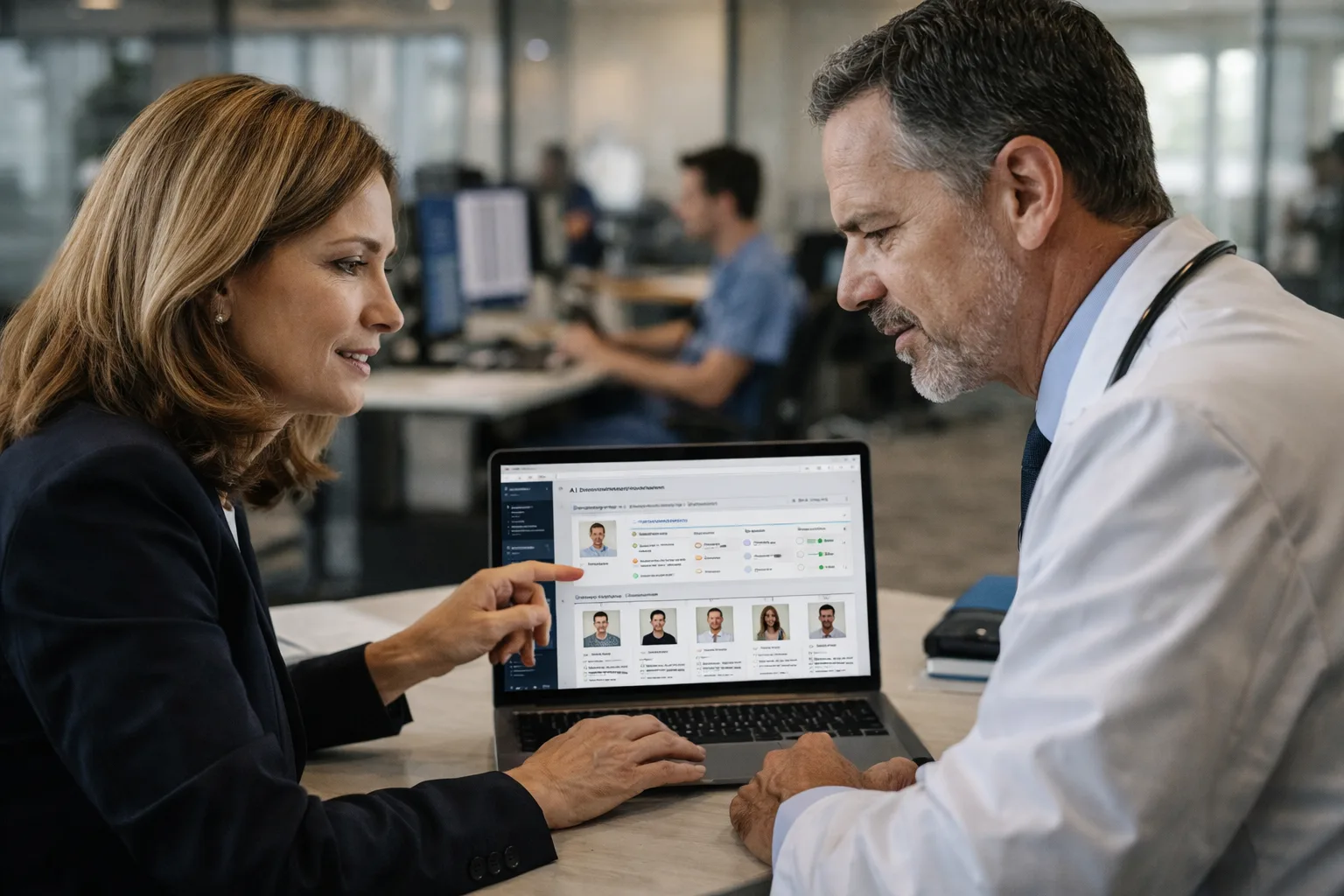
One of the biggest mistakes the market makes with AI is assuming the technology itself is the strategy.
It is not.
In healthcare, AI becomes useful only when it is placed inside the right workflow, at the right moment, with the right human control around it. That is exactly what recent evidence is starting to show. A 2025 JAMA Network Open survey study of 1,430 clinicians across two academic medical center systems found that ambient documentation technology was associated with reductions in burnout and improved well-being scores compared with baseline. The lesson was not that clinicians became unnecessary. The lesson was that the workflow improved when repetitive burden was reduced in a structured, controlled way. (JAMA Network)
That is the principle healthcare recruiting should adopt as well.
The market still talks about AI in hiring too loosely. Some vendors talk as if AI itself is the answer. Some buyers react as if AI must therefore be the threat. Both views miss the real point. The useful question is not whether AI can “do hiring.” The useful question is whether AI can reduce the parts of the hiring workflow that are repetitive, delay-prone, and administratively expensive, while keeping human judgment where trust, fit, and accountability matter.
In healthcare, that distinction matters more than in many other sectors. Recruiting here is not simply about finding a candidate and pushing them into an interview loop. It is tied to readiness, role suitability, scheduling complexity, credential-awareness, stakeholder alignment, and speed under pressure. The process is too important and too nuanced to become a black-box automation exercise. But it is also too burdened by manual work to remain fully human-powered in the old sense.
That is why human-in-loop AI is not a compromise model. In healthcare, it is the serious model.
When workflow leads, AI can do the kind of work that drains time without adding much strategic value. It can assist with shortlisting, move candidates through early steps faster, reduce repetitive follow-up, support scheduling, summarize process information, and make the workflow more visible. The recruiter, hiring manager, and staffing leader remain central—but they are no longer forced to spend such a large share of their attention on process friction. That is the real value proposition. Not replacement. Relief with accountability.
This is where Gigin.Health fits into the market more naturally than many AI products do. Its public positioning is not “AI replaces your recruiters.” It is a healthcare ATS plus agentic suite, with Gia as an AI recruiter helping across sourcing, shortlisting, scheduling, and repetitive workflow tasks, while the broader system keeps hiring visible from application to onboarding. The site explicitly presents this in a healthcare-specific context and frames it around faster movement, easier workflow control, credential-check automation, and a secure, compliant environment. That is a far more believable direction for healthcare than abstract claims about autonomous recruiting. (gigin.health)
The broader market lesson is clear. In healthcare hiring, AI should follow workflow discipline, not substitute for it. The stronger systems will be the ones that use AI to reduce burden and improve movement while keeping human professionals in charge of the judgment-heavy points in the process.
That is how AI becomes operationally credible in healthcare. It stops being a headline and starts becoming part of the hiring infrastructure.
Healthcare organizations and staffing teams exploring a more practical, workflow-led, human-in-loop AI hiring model can explore Gigin.Health via gigin.si or write to info@gigin.ai.
Further reading
More from Gigin
- Human-in-the-Loop Is Not a Compromise. It Is Correct Architecture.
- AI Should Remove Administration, Not Judgment
- Most AI Hiring Tools Record What Happened. Gia Executes the Workflow.
- What Good Guardrails Look Like in Production Agent Systems
- Healthcare Does Not Need More Hiring Tools. It Needs One Connected Workflow.
