
The Real Unit of Design in Hiring Is Not the Prompt. It Is the Workflow.

AI has pushed a lot of teams into prompt-first thinking.
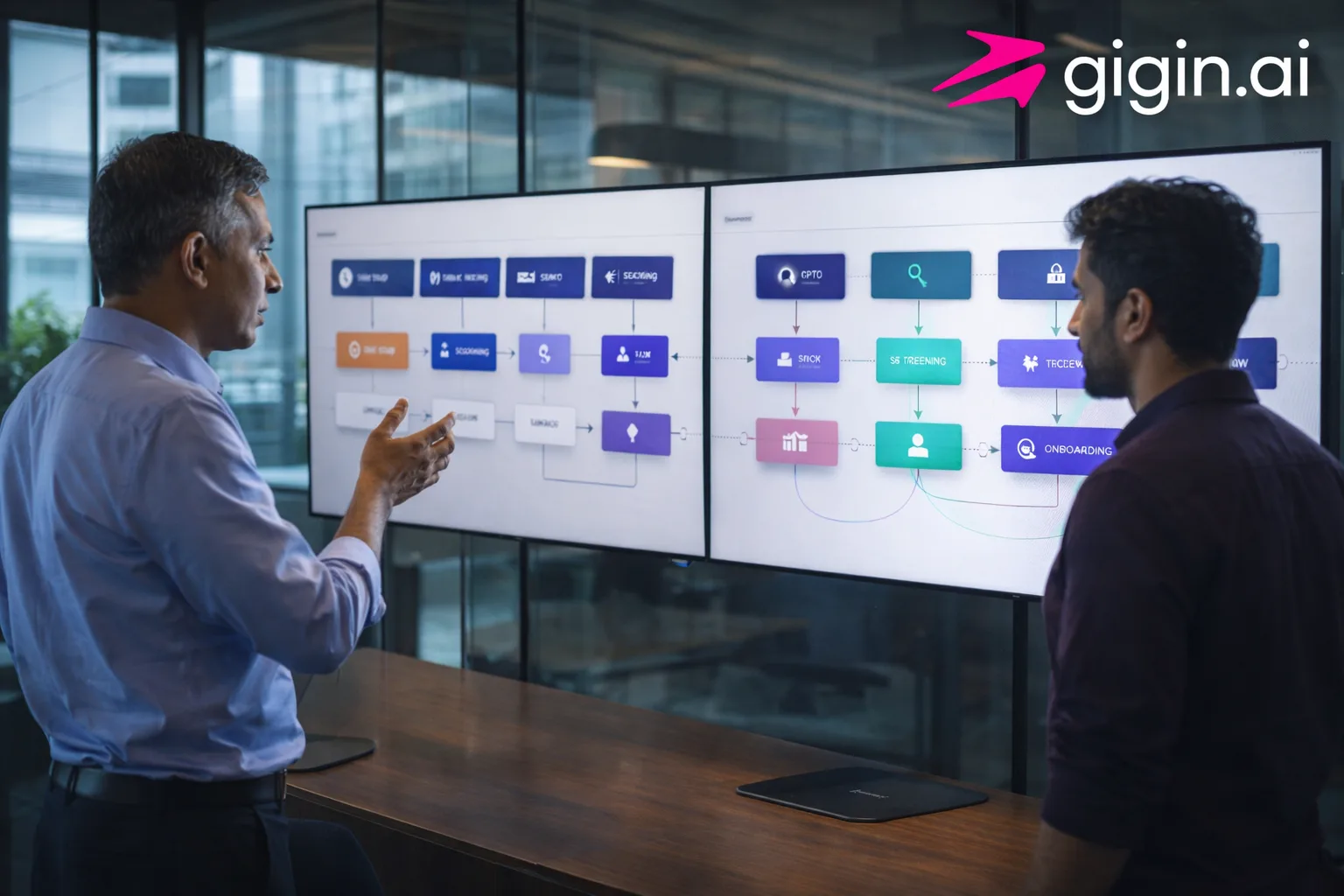
That is understandable in early experimentation. Prompts are visible. They are easy to tweak. They create immediate output. But if you are building serious software, the prompt is not the real unit of design. The workflow is. Anthropic’s work on Contextual Retrieval is a useful reminder of this. It showed retrieval failures could be reduced by 49%, and by 67% when combined with reranking, simply by improving how context is prepared and passed into the system. That is the deeper lesson: better results often come not from “smarter wording” but from better context architecture. (anthropic.com)
The same pattern is visible in official agent guidance. OpenAI describes agents as systems built from instructions, tools, memory or state, and orchestration, not as prompt-only applications. Its practical guide emphasizes that workflow execution in multi-step systems depends on state and on how agents or tools are coordinated over time. This matters because the hiring process is not a blank canvas every time. It is a stateful journey with role context, candidate context, prior actions, stage movement, and changing business urgency. (OpenAI)
That is why so many AI hiring products still feel shallow. They create useful outputs, but they do not carry enough workflow awareness to feel genuinely intelligent across time. They can answer a question, but they do not always understand what has already happened, what should happen next, or how to preserve continuity between stages. In other words, they generate text without really understanding the process they sit inside.
This is where Gigin’s broader design direction matters. The company is not only moving toward a conversational interface. It is moving toward a context-aware hiring operating model, where workflow continuity matters as much as model capability. That distinction is critical. A conversational surface only becomes powerful if there is enough structured memory, workflow state, and internal truth underneath it. Otherwise, you get a nicer UI on top of a weak context system. But when the underlying architecture is stronger, the conversational layer becomes meaningful: it reduces search friction, shortens task switching, and makes the product feel progressively more relevant as the workflow accumulates context.
That is why the real unit of design in hiring is not the prompt.
It is the workflow.
It is the state.
It is the continuity.
The companies that understand this will build products that feel more intelligent for the right reasons. The ones that do not will keep shipping AI moments that look good in demos but lose coherence in production.
That is one of the most important technical distinctions in the category right now.
And it is one Gigin should continue to own.
Further reading
- Effective context engineering for AI agents — Anthropic
- Announcing the Agent2Agent Protocol (A2A) — Google Developers Blog
