
Why Workflow-Native AI Will Beat AI Wrappers in Hiring

The hiring-tech market is entering a new phase, and most people are still looking at the wrong signal.
The obvious signal is the explosion of AI features. Every product now seems to have an assistant, a copilot, an agent, or an automation layer. But the deeper signal is architectural: the market is moving away from AI as a feature and toward AI as a system. That shift is already visible in the broader enterprise world. Microsoft’s 2025 Work Trend Index, based on survey data from 31,000 people across 31 countries, says 82% of leaders believe this is a pivotal year to rethink key aspects of strategy and operations, and 81% expect agents to be moderately or extensively integrated into their AI strategy within the next 12–18 months. NVIDIA’s 2026 State of AI report, based on 3,200+ respondents, says 44% of companies were either deploying or assessing AI agents in 2025. This is not marginal experimentation anymore. It is the beginning of a systems shift. (assets-c4akfrf5b4d3f4b7.z01.azurefd.net)
The problem is that much of hiring tech is still responding to this shift at the wrong layer. It is adding AI to screens instead of redesigning the workflow itself. That produces products that can summarize resumes, generate JDs, or draft messages but still depend on humans to manually carry context from one stage to another. OpenAI’s current agent guidance makes it clear that serious agents are not just prompts. They are systems built from models, tools, memory or state, and orchestration. In other words, the real product is not the response. The real product is the workflow that governs how responses become actions. (OpenAI)
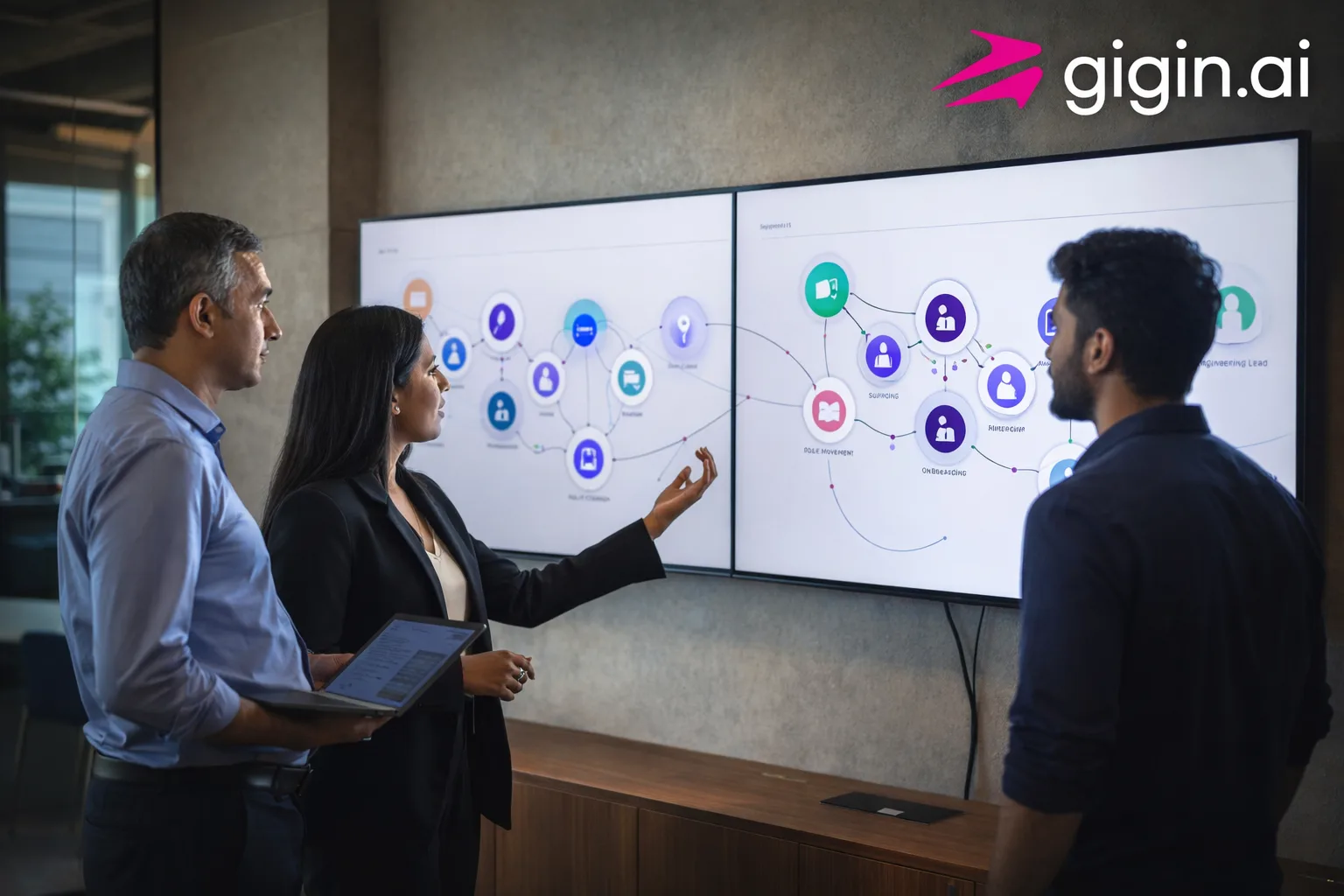
Hiring is exactly the kind of domain where that distinction matters. It is not one task. It is a chain of state transitions: role definition, sourcing, qualification, movement through workflow, trust checks, scheduling, interview progression, and final decision. A thin AI wrapper can improve one step. A workflow-native system can improve the continuity of the whole chain. That is the difference between an AI trick and an operating model.
This is where Gigin’s technical direction becomes important. The point is not that Gigin uses AI. The point is that Gigin is building toward a natively integrated, workflow-centric hiring system where sourcing, workflow, trust, interoperability, and agentic intelligence reinforce each other. That is a stronger position than shipping isolated AI features over disconnected tools. It allows the product to become more context-aware, more personalized, and more useful over time because the workflow itself is designed to carry more meaning, not just more output.
That is why I believe workflow-native AI will beat AI wrappers in hiring.
Wrappers can look good quickly.
Workflow-native systems get stronger with scale.
And in the long run, systems that preserve continuity, reduce switching costs, and make the hiring process feel naturally intelligent will outperform products that only add AI moments to otherwise fragmented workflows.
That is where the category is going.
And that is where Gigin is aiming.
More from Gigin
- Most “AI Recruiters” Are Thin Layers. The Winning Stack Will Be Native.
- The Real Unit of Design in Hiring Is Not the Prompt. It Is the Workflow.
- Why Orchestration Is the Real Product in Agentic Hiring
- Deterministic Systems + Agentic Systems = The Winning Stack
- What Gigin Means by a Natively Integrated Hiring Stack
